Most advice on how to manage remote employees reads like a shopping list: buy this chat app, schedule that meeting, install some tracker. We think that’s backwards. Tools come last. What comes first is a handful of boring agreements between you and your team about what good work looks like, how you’ll talk, and how you’ll know when something’s going wrong.
This guide is our take on those agreements. We make employee monitoring software (DeskTrack), so yes, we have a bias. We’ll point out where a spreadsheet does the job just as well, because for a small team it often does.
To manage remote employees effectively, set written output goals for each role, agree on communication rules and core hours, hold a short daily check-in and a weekly 1:1, and review results with a weekly scorecard and a monthly goal review. Use activity data only to ask better questions, and tell your team exactly what you track.
What is DeskTrack? DeskTrack is employee monitoring and AI workforce analytics software for remote, hybrid and field teams. Its AI agent is called Desky, and its sister product for tasks and projects is TitaPro.
In this guide: Why it’s harder · Goals and communication · Check-ins · Tracking work · Measuring performance · Weekly scorecard · Transparency · Time zones and onboarding · Engagement · When output drops · Desky · Tools
Why is it harder to manage remote employees?
In an office, in our experience a lot of management happens by accident. You see who’s swamped, you overhear a client call going badly, you notice someone’s gone quiet. Take the office away and all of that disappears at once. What’s left is a Slack status dot and whatever people choose to tell you.
The usual complaints (slow answers, broken handovers across time zones, people quietly checking out) are mostly symptoms of that one loss. So the fix isn’t to recreate the office on video. It’s to agree on a few simple habits that replace the free visibility you used to get. That’s what the rest of this post is about, and it works whether your team is fully remote, hybrid or out in the field.
Remote team management is a mainstream problem now, not a niche one. Gallup’s data for 2026 puts 52% of remote-capable US employees in hybrid roles, 26% fully remote and 22% on-site, so most knowledge teams already work apart for at least part of the week.
If you run the business, it also helps to know what you’re aiming at. Good remote management should show up in four places: work finishing when it was promised, a clear view of where paid time goes (so you can price projects and spot unprofitable clients), managers who spend their week coaching instead of chasing updates, and your best people not working 60-hour weeks. If none of those improve, the system isn’t working, however tidy it looks.
How to set goals and communication rules for remote teams
“Be productive” isn’t a goal. When people sit in different places, a vague goal turns into either overwork or drift, and by the time you notice, it’s been weeks. For each role, write down what finished work looks like (“10 client reports a week”, “first reply on support tickets within 2 hours”), what counts as good enough, and which hours people need to be reachable. Review it monthly, because a goal nobody revisits is forgotten fast.
The research points the same way. A 2024 Gallup and Workhuman study of 4,439 US employees found that clarity of expectations had declined across the workforce over five years, and that hybrid and remote employees saw it decline at twice the rate.
Then agree on communication rules, and keep them to one page. Which channel is for what: chat for quick questions, email for clients and decisions, video for anything that needs tone. How quickly people should reply during core hours. And a habit we’d push hard: write things down. A written update lets a colleague in another time zone catch up on their own schedule instead of waiting a day for you to wake up. Written decisions also stop the “I thought we agreed” arguments that waste more time than the original problem.
A shared doc and a pinned message are enough here. You don’t need software for this part.
How often should you check in with remote employees?
People don’t hate meetings as much as they hate unpredictable ones. We’d rather run a few short check-ins that never move than a pile of long ones that keep shifting.
| Check-in | How often | Length | What it’s for |
| Team stand-up (live or written) | Daily | 10–15 min | Today’s plan, blockers |
| 1:1 with each direct report | Weekly | 20–30 min | Progress, support, growth |
| Goal review | Monthly | 45 min | Output against targets |
| Performance review | Quarterly | 60 min | Trends, feedback, career |
Here’s a rule of thumb: if you feel you need more meetings than this, you probably can’t see the work, and the meetings are filling that gap. Which brings us to the next problem.
How to track remote employee productivity without micromanaging
Micromanaging means pinging someone all afternoon because their status dot went grey. Visibility is quieter. The work is recorded automatically, the employee can see the same numbers you can, and you look at the pattern over weeks, not at one bad Tuesday.
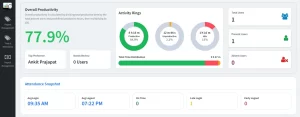
This is a DeskTrack day view for one employee. It shows login time, time at work, all recorded automatically, with no timesheet. The bar in the middle shows when the computer was active (green) and idle (red).
If you’re a five-person team and this feels like overkill, it probably is. A two-line end-of-day note from each person gets you most of the way there.
How to measure remote employee productivity (and what activity data can’t tell you)
To measure remote employee productivity, define what finished work looks like for each role and track output against it: reports delivered, tickets resolved, deals moved, deadlines met. Use activity data such as productive and idle time only as supporting context, and compare each person with their own trend and with others in the same role.
We’ll be blunt, because this is where tracking tools get misused. Activity data shows when people work, which tools they use, and how time splits across projects. It can’t show quality. It can’t see someone thinking on a walk, sketching on a whiteboard, taking a call on their personal phone or reading a printed contract. And if a role’s tools haven’t been marked as productive, good work will show up as “unproductive”, so check the setup before you blame the person.
In our experience, teams with high computer activity can still deliver late, and people with modest screen time can produce some of the best work on the team.
This is also why productivity should be measured per role. A designer lives in design tools, a salesperson is on calls, a developer is in an editor. DeskTrack calculates productivity as productive time divided by scheduled office hours, with the productive apps defined for each role plus customer calls, meetings and field time. The formula is visible, so employees can check their own number. A score above 100% means someone worked past office hours. We treat that as a burnout warning, not a gold star. (This productivity score is a different measure from the project-hours ratio in the scorecard below.)
Free weekly scorecard template for remote employees
Accountability works when three things are true: the target is clear, both sides can see the result, and there’s a fixed time to look at it together. A one-page weekly scorecard covers all three. It takes about five minutes to fill in and replaces most of the “quick status update?” messages that clog a manager’s day.
Copy this into any spreadsheet. It works with or without DeskTrack.
| Measure | Target | Notes |
| Committed outputs delivered | e.g. 10 reports | |
| Deadlines met / missed | All met | Reason for any miss |
| Quality signal (rework items or client returns per week) | 0–1 | |
| Project-hours ratio (project hours ÷ total working hours) | Set per role | Optional, from your tracking tool |
| Hours beyond schedule | Under 10% | Overload check |
| One blocker | ||
| One thing I need from my manager |
The project-hours line (a different measure from the productivity score above, which is productive time divided by scheduled office hours) is where tracking data earns its keep. The report below compares, for each employee in September, total working hours with the hours DeskTrack allocated to client projects based on the files and folders each person worked in.
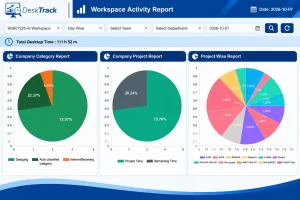
A gap like Employee 01’s is a question, not a verdict. The rest of the time might be meetings, internal work, support, training, or project work in folders nobody linked to a project yet. In the 1:1, just ask what filled that time. If it was valuable work, link those folders so next month’s numbers are accurate. If it wasn’t, you’ve caught a planning or workload problem while it’s still cheap to fix.
How to be transparent about employee monitoring
If you track work at all, trust is the whole game. People accept monitoring far more easily when they know four things up front: what’s collected, who sees it, how long it’s kept and why. Here’s how DeskTrack answers each one, and you should be able to give the same clear answers for whatever tool you use.
| Question | Our answer |
| What is tracked? | Apps and URLs used, window titles and file names, active and idle time, attendance and, if you switch them on, screenshots. File contents are never read. There’s no keystroke logging, webcam capture, video recording or live screen streaming. |
| Who can see it? | Managers and admins see their own team. Employees see their own data in a self-view. Only admins can download screenshots. |
| How long is it kept? | Screenshots are kept for one month. The minimum screenshot interval is 5 minutes, and screenshots can be turned off completely. |
| Why is it tracked? | Tell your team in writing, for example: project costing, workload balance and attendance. Then use the data for those things only. |
In the US, “New York, Connecticut and Delaware each have a law on notice of electronic monitoring. New York requires notice at hiring that the employee acknowledges, plus a posted notice. Delaware lets employers choose between a daily electronic notice and a one-time notice. Connecticut updated its law with effect from 1 October 2026. Other places have their own rules, so check the current text for where your people work.
One small habit changes the tone of the whole programme. When you spot a pattern, open with “I noticed this. What’s going on?” and not “The data shows you were idle.” The first starts a conversation. The second starts a defence.
How to manage remote employees across time zones (and onboard new hires)
Time zones usually break at the handover. What helps is dull but effective: publish everyone’s working hours in one shared place, protect two or three overlap hours for live work, and rotate meeting times so the same people don’t always take the late call. End each day with a short note covering what’s done, what’s in progress and what’s blocked. And judge people by the deadlines they meet, not the hours they keep.
Onboarding deserves the same planning, because a remote hire’s first month decides whether they feel part of the team or left alone with a laptop. Get their equipment, accounts and tools ready before day one and book a welcome call. Give them a buddy for daily questions and one small task they can actually finish in week one. By day 30 they should have written goals and a weekly 1:1, and it helps to sit down once and look at their own productivity view together, so tracking feels normal from the start instead of like a surprise.
How to keep remote employees engaged and motivated
Virtual social events are fine, but they don’t do much on their own. What keeps people engaged is mostly ordinary. Specific recognition lands better than general praise: “your report saved the client renewal” means something, “great job, team” doesn’t. Once the outcome is clear, give people freedom over how and when they work within core hours. Let them see their own progress. Spend part of every 1:1 on skills and career, not only tasks.
Retention is worth the effort. In a randomised trial of more than 1,600 employees at Trip.com, published in Nature in 2024, a hybrid schedule (two days a week at home) cut quits by 33% with no measurable effect on productivity or promotions. It’s one company and a hybrid schedule, not fully remote work, so treat it as a signal rather than a guarantee.
And watch for the quiet danger on the other side: someone running above 100% productivity for several weeks in a row. In our experience, that person isn’t a star, they’re at risk of burning out and leaving. Check in before they do.
What to do when a remote employee’s output drops
This is the hardest part of remote management, and the place where data helps most if you use it gently. Work through it in this order:
- Look at two to four weeks of data, not one. Everyone has a bad day.
- Look for the cause before you judge. Unclear goals, the wrong tools, too much work and personal trouble all look like low output in a report.
- Talk privately, on video, never over chat. Say what you see and ask what’s going on.
- If there’s a real gap, agree a written plan: two or three measurable targets, the support you’ll give and a review date, usually 30 days out.
- Check progress weekly on the scorecard you both can see.
There’s a bonus in this. Shared numbers take the “who actually did more” argument off the table, which is fairer to the quiet high performers who are so easy to overlook when you can’t see them across the room.
How do you manage hybrid teams and remote sales staff?
Hybrid teams can quietly split into the people the boss sees and the people the boss doesn’t. Use the same goals, check-ins and measures for everyone, wherever they sit, and record office punch-in and remote login in one attendance report so nobody’s effort is counted differently.
Sales teams need one extra layer: link activity to the pipeline. Each week, look at time on customer calls, follow-ups sent and deals that moved a stage. DeskTrack counts customer calls and meetings as productive time. Calls to internal office numbers aren’t counted, so the call figure reflects time spent with customers.
How can managers get productivity data without chasing reports?
Every habit above needs the right number at the right time, and in most companies that means asking someone and waiting for the answer.
Our founder, Rashmi Singh, used to export DeskTrack data and paste it into an AI chat tool by hand before every review meeting, and in busy weeks she skipped it. That’s why we built Desky, an AI agent that answers questions about your DeskTrack data in plain English, with the numbers and how it calculated them. Here’s an answer to “What did idle time cost us this month?”
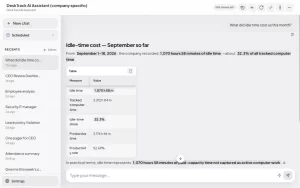
It can also handle questions that are tedious to answer by hand, such as whether your team’s use of AI tools is linked to productivity, and it can send a saved question to your email or WhatsApp as a weekly report.
What does a weekly routine for managing remote employees look like?
Put together, a normal week looks like this. Mornings start with a 10-minute stand-up or a written update. On Monday the manager reads the weekly report and picks two or three things to act on. Midweek is for 1:1s, using each person’s scorecard. Friday is for recognising specific wins and confirming next week’s priorities. At month end you review goals and check for overload, and at quarter end you run performance reviews and reset goals. That’s the whole system. It’s meant to be dull.
What tools do you need to manage a remote team?
One tool per job, and never two doing the same job: team chat, video meetings, a task or project tracker (our sister product TitaPro covers that), a shared docs space for decisions, and one tool for time, attendance and productivity. DeskTrack fills that last slot for remote, hybrid and field teams, on Windows, Mac and Linux, with mobile apps for field staff.
It isn’t right for every team. If you have three or four people who talk all day, a spreadsheet and the scorecard above will serve you better than any software.
Common remote management mistakes
- Judging people by their status dot. Being online isn’t the same as getting work done. Measure output against the goals you wrote down.
- Adding meetings to fix a visibility problem. More calls rarely help. Short, predictable check-ins and written updates do more.
- Tracking without explaining. If people find out about monitoring on their own, trust drops fast. Say what’s collected, who sees it and why, before you start.
- Using one productivity yardstick for every role. A designer, a salesperson and a developer work differently, so define productive work per role.
- Missing the quiet overworkers. Long hours look like dedication until someone resigns. Watch for weeks above 100% productivity.
Common remote team management advice that doesn’t work
A few things you’ll read elsewhere that we don’t fully agree with:
- “Just trust your people and don’t measure.” Trust matters, but a gap between what you think is happening and what is happening is how projects slip quietly. Measuring openly is a way of being fair, not a lack of trust.
- “More video calls build culture.” Usually they just build calendar clutter. Short, predictable check-ins and good written updates do more.
- “Track everything.” Please don’t. Collect what you can explain to your team in one sentence, and stop there.
Conclusion: Build the System First
Managing remote employees comes down to four habits: clear goals, short regular check-ins, data both sides can see, and acting early when something drifts. None of it is fancy, and most of it fits on one page.
So start small. This week, fill in the scorecard in a plain spreadsheet. Once your team trusts the routine, tracking data can make it faster and more accurate. Not before.
Ready to see your own team’s week? Start your free trial or see how DeskTrack works. 15 days free, no credit card.
Frequently asked questions
Q. How do you manage remote employees effectively?
Treat it as a weekly routine, not a one-off fix. Give each role written output goals, agree on communication rules and core hours, hold a short daily check-in and a weekly 1:1, and review results against the goals every week. A 20-person team with two managers can run this with a 10-minute daily stand-up, about ten 20-minute 1:1s per manager each week, and one shared scorecard.
Q. How do you track remote employees without micromanaging?
Track automatically, explain what you track, and review patterns weekly instead of reacting to single moments. A quick test: if you’re messaging people to ask what they’re doing, you’re micromanaging. If you’re reading a weekly report and asking about one trend, you’re managing. Let employees see their own data too.
Q. How often should you check in with remote employees?
A 10–15 minute team check-in daily, a 20–30 minute 1:1 weekly, a goal review monthly and a performance review quarterly. New hires and anyone on an improvement plan need more contact, usually a short 1:1 twice a week for the first month.
Q. How do you motivate remote employees?
Give specific recognition tied to an outcome, freedom over how the work gets done once the goal is clear, and regular talks about growth. Also watch for overwork. Someone far beyond scheduled hours for several weeks is more likely to burn out than to stay motivated.
Q. How do you measure remote performance fairly?
Measure what the role is responsible for delivering, such as reports filed, tickets resolved or deals moved. Use activity data like productive and idle time only as supporting context. Compare a person with their own trend and with others in the same role, never a different role, and find the cause of any change before acting on it.
Q. How do you manage remote employees across time zones?
Agree a few overlap hours when everyone is reachable, and run everything else asynchronously with written updates. A shared schedule of working hours and a daily done / in progress / blocked note keep handovers from dropping, and deadlines, not clock hours, become the measure of performance.
Q. What tools do you need to manage a remote team?
A workable stack has one tool for each job: messaging, video calls, task tracking, shared documents and, if you want time and attendance data, an employee monitoring or workforce analytics tool. The test is overlap. If two tools do the same job, drop one.