Remote employee monitoring software tracks how work happens outside a traditional office time, application activity, and sometimes attendance or screenshots so managers get visibility they’d otherwise lose without a physical workplace.
Four US states (Connecticut, Delaware, New York, and Texas) currently require some form of written or posted notice before electronic monitoring begins. Check your state before rolling anything out.
The tools that hold up long-term measure activity as a signal, not a verdict, and connect it to actual output and business outcomes rather than treating logged hours as the goal.
If you’re evaluating remote employee monitoring software for a distributed or hybrid team, you’re not the only one hybrid and remote arrangements are now the default for most remote-capable US roles, not the exception. This guide covers what these tools actually do, how to monitor employees working from home in a way that holds up legally and doesn’t wreck team trust, and how to tell a genuinely useful platform from one that just generates activity noise.
What is Remote Employee Monitoring Software?
Remote employee monitoring software is a category of tools that record how employees spend working hours when they aren’t physically supervised typically through time tracking, application and website activity logs, attendance records, and in some cases screenshots or GPS data. It exists to replace the informal visibility a manager gets by walking past a desk, not to replicate constant surveillance.
The category is broader than most people assume when they first search for work from home monitoring software. It generally breaks into a few distinct layers, and most platforms combine two or more:
- Time tracking: manual or automatic logging of hours against tasks or projects.
- Activity monitoring: records of application usage, website visits, and idle periods.
- Attendance verification: clock-in/clock-out records, sometimes tied to biometric or location data.
- Visual verification: periodic or triggered screenshots, used mainly in compliance-heavy or client-billed work.
- Data-loss prevention: monitoring of file transfers, USB activity, or web uploads, aimed at security rather than productivity.
Why This Category Grew So Fast
This isn’t a passing trend tied to a single pandemic-era decision. According to Gallup’s ongoing workplace research, roughly 52% of remote-capable U.S. employees now work in a hybrid arrangement and another 27% work fully remote meaning close to eight in ten remote-capable employees spend at least part of their week outside a traditional office (Gallup, reported via HR Dive, 2025). That’s a structural shift in how work gets supervised, not a temporary gap to wait out.
At the same time, SurveyMonkey’s remote and hybrid workplace research found that 82% of all employees in-office or remote admit to spending some work-hour time on non-work activity (SurveyMonkey, 2025). The same research found something worth sitting with: remote employees are almost twice as likely as in-office employees to say their manager actually trusts them. Distraction isn’t a remote-work-specific problem. Feeling distrusted, when it happens, doesn’t map neatly to work location either.
Put simply: companies didn’t lose the need for visibility when offices emptied out. They lost the ambient information a manager used to pick up by accident. Monitoring software, done responsibly, is an attempt to replace that not to exceed it.
No Credit Card Required
Know What’s Happening When Your Team Works Remotely
Track activity, understand productivity gaps, and build visibility—without turning monitoring into surveillance..
The Three-Layer Framework: Activity, Output, and Business Outcome
This is the single most important distinction in this entire category, and it’s the one most vendor content glosses over. Employee productivity should be evaluated across three separate layers, not collapsed into one number:
| Layer | What It Measures | Where It Falls Short Alone |
|---|---|---|
| Activity | Time logged, apps used, keystrokes, idle gaps | Tells you someone was busy not whether the work mattered |
| Output | Tasks completed, deliverables shipped, tickets closed | Doesn’t capture quality, or whether the right things got prioritized |
| Business outcome | Revenue impact, client retention, cost-per-deliverable | Slow to move and hard to attribute to a single person or day |
A common and costly mistake is treating activity data as a proxy for the whole picture. High activity with low output usually points to a workflow or workload problem, not a discipline problem. Low activity with strong output often just means someone works in efficient bursts. Reading activity data in isolation without the other two layers is how monitoring programs end up punishing the wrong behavior.
How to Monitor Employees Working From Home Without Losing Their Trust
The sequence matters as much as the tool. Skipping a step here is where most rollouts go wrong, regardless of which platform is involved.
1. Decide the actual business question first. “We want to see workload distribution” leads to a very different setup than “we need compliance evidence for client billing.”
2. Check your state’s notice requirements before switching anything on (see the legal section below).
3. Tell the team directly, in a real conversation, before rollout not through a policy update nobody reads.
4. Default to team-level and role-level reporting. Drill into an individual’s data only when there’s a specific, stated reason.
5. Give employees visibility into their own data. If a manager can see it, the employee should see the same thing about themselves.
6. Pair any data review with a conversation. A number without context regularly leads to the wrong conclusion.
| WHY THIS MATTERS
Visibility and surveillance are not the same thing, even though they can use identical software. Visibility helps a manager spot a bottleneck, a burnout signal, or an uneven workload. Surveillance treats every data point as evidence against an individual. The line between the two is set by intent, transparency, and how the data gets used not by the feature list. |
Is Remote Employee Monitoring Legal? What US Employers Actually Need to Know
In the United States, monitoring company-owned devices and accounts is broadly legal when there’s a legitimate business reason. But “legal” and “no obligations” aren’t the same thing. As of 2026, four states have specific statutes requiring notice before electronic monitoring begins:
| State | Core Requirement | Statute |
|---|---|---|
| Connecticut | Prior written notice; conspicuous workplace posting required | Conn. Gen. Stat. § 31-48d |
| Delaware | One-time written notice with acknowledgment, or daily electronic notice | Del. Code tit. 19, § 705 |
| New York | Written or electronic notice upon hiring, posted conspicuously | N.Y. Civil Rights Law § 52-c |
| Texas | Notice requirements apply to specific monitoring contexts | Tex. Penal Code (monitoring provisions) |
This is general information, not legal advice requirements change, and other states are actively considering similar bills. Confirm current requirements with counsel before rollout, especially if your team spans multiple states (sources: Holland & Knight legal analysis, 2022; state statutes as cited above).
Work From Home Tracking Software: What to Actually Evaluate
When comparing work from home tracking software, most buying guides lead with feature checklists. A more useful approach: match the tool’s depth to the actual decision you need to make.
| Tool Type | Best Use Case | Limitation to Know Going In |
|---|---|---|
| Lightweight time tracking | Billing accuracy, simple project time allocation | Doesn’t explain what happened during logged hours |
| Activity + app/URL tracking | Understanding where team hours actually go | Activity ≠ output; needs context to interpret fairly |
| Screenshot monitoring | Compliance-heavy or client-audited work | Can feel invasive if used by default rather than by exception |
| Biometric attendance | Preventing proxy clock-ins across shift-based teams | Only solves attendance accuracy, not productivity questions |
| DLP / data-loss protection | Regulated industries, sensitive IP protection | A security tool, not a productivity one don’t conflate the two |
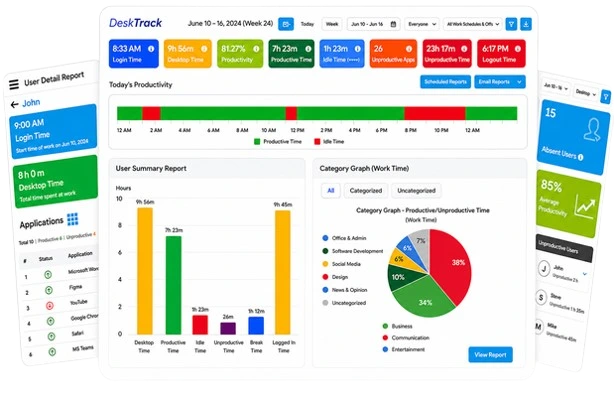
This is where a platform like employee monitoring software needs to be evaluated honestly against what your team actually needs. DeskTrack, for example, combines automatic employee time tracking software with activity and application tracking, biometric attendance integration, and optional screenshot monitoring software that’s configurable rather than blanket-applied. According to DeskTrack’s own published customer data across its installed base, teams using the platform report an average productivity increase in the high-20s percentage range and measurable reductions in idle time figures the company reports from its aggregated deployments, not an independent third-party study, so treat them as vendor-reported context rather than universal benchmarks.
Common Mistakes in Remote Team Monitoring
- Applying the same monitoring depth to every role. A support rep answering tickets all day and a strategist thinking through a problem for two hours need different visibility, not identical dashboards.
- Treating idle time as guilt by default, without checking for calls, meetings off-platform, or genuine thinking time.
- Rolling out the tool through IT alone, with no manager training on how to read the data responsibly.
- Using monitoring data punitively in week one, before establishing what normal patterns even look like.
- Never revisiting the policy as the company grows past its original size and structure.
A Practical Checklist for Managers and Employees
For managers rolling this out
- Confirm your state’s notice requirements before enabling monitoring.
- Write the policy in plain language what’s tracked, who sees it, and why.
- Set a review cadence (monthly or quarterly) instead of a one-time launch.
- Use team-level trends as the default lens, not individual leaderboards.
For employees being monitored
- Ask specifically what is and isn’t being tracked on your devices.
- Request access to your own activity data if it isn’t offered by default.
- Raise it directly with your manager if a metric seems to misrepresent your actual work.
Remote Work Monitoring for Hybrid and Fully Distributed Teams
Hybrid and fully remote teams need slightly different approaches to remote working monitoring. Fully distributed teams typically lean more on asynchronous activity data since there’s no in-office baseline to compare against. Hybrid teams benefit from comparing in-office and remote days side by side which, done carefully, can actually reveal whether office presence correlates with anything measurable at all, rather than assuming it does.
This is also where productivity monitoring software earns its keep over basic time tracking: it can show whether a shift to more remote days changed output, not just whether hours were logged.
Implementation Plan: Rolling Out Monitoring Software in Practice
Week 1: Define the specific question you’re trying to answer, and confirm legal notice requirements for every state you employ people in.
Week 2: Communicate the plan directly to the team, including what’s tracked, what isn’t, and who has access.
Weeks 3–6: Run in observation mode. Collect baseline data without making decisions from it yet.
Week 7 onward: Review team-level trends monthly, pairing any notable pattern with a direct conversation before drawing conclusions.
Where This Leaves You
The employers who get the most out of remote employee monitoring software treat it as a visibility tool, not a verdict machine. Confirm the legal notice requirements for your states, communicate clearly before rollout, and connect activity data to output and business outcomes rather than reading it in isolation.
If you’re at the stage of evaluating tools rather than just reading about the category, it’s worth seeing what a transparent, employee-visible approach looks like in practice that’s the model how to monitor remote employees responsibly is built around at DeskTrack, including a self-view dashboard so employees see the same data managers do.
Frequently Asked Questions (FAQ)
Ans. Generally yes, when monitoring company-owned devices and accounts for a legitimate business reason. Connecticut, Delaware, New York, and Texas currently require specific forms of notice before monitoring begins. This is general information, not legal advice confirm current requirements with counsel for your specific states. Ans. Indirectly, and only when the data leads to fixing root causes uneven workloads, unclear priorities, or broken workflows. Using monitoring purely to apply pressure tends to increase turnover without a lasting productivity gain. Ans. Activity measures what someone was doing apps open, time logged, keystrokes. Productivity connects that activity to actual output and, ideally, business outcomes. High activity doesn’t guarantee high output, and low activity doesn’t necessarily mean low output. Ans. No, Screenshot monitoring software makes the most sense for compliance-heavy or client-billed work where visual proof is genuinely required. For most knowledge work, it should be optional and used deliberately, not switched on by default. Ans. Small teams often rely more on direct, frequent conversation and need lighter tooling, since a manager overseeing five people already has reasonable day-to-day visibility. Larger organizations need more structured, consistent data because that informal visibility doesn’t scale. Ans. Match tool depth to your actual question: lightweight time tracking for billing accuracy, activity tracking for workload visibility, screenshot or DLP tools only where compliance or security genuinely requires them.remote-employee-monitoring