To monitor employee computer activity is to record how company computers are used during working hours, so managers can see where paid work time goes. Good monitoring records work signals. It does not read private content. Here is the line DeskTrack draws:
| ✓ What DeskTrack records | ✗ What DeskTrack never records |
| Login and logout time, active time and idle time | Keystrokes (no keylogging) |
| Apps used and time spent in each | File contents. Only file names and dates are seen |
| Websites (URLs) and window titles | Webcam photos or microphone |
| File and folder names people work in | Video recording or live screen streaming |
| Screenshots at an interval you set (minimum 5 minutes), or none | Reading text on the screen (no OCR) |
The right-hand column lists features DeskTrack does not have at all, so no admin can turn them on. Three settings are chosen by the admin:
- Visible or silent: visible is the default, and employees can see their own data. Silent mode exists, but use it only where local law and your written policy allow it, and say in the policy that it may be used.
- Screenshots: off, or on at an interval of 5 minutes or more, set per team. Only admins can download them, and they are kept for one month.
- Hours: tracking follows the work schedule you set.
What activity data can and cannot tell you
Computer activity shows which apps and websites were used, for how long, and when the computer was idle. It cannot show the quality of the work, thinking or paper work done away from the keyboard, calls on a personal phone, or why someone did something. A low score is a reason to ask a question. It is not proof of low effort or misconduct.
Looking for your laptop’s location? Some people search “tracking my laptop” to find a lost device. That is an IT asset or device-finder tool. Employee computer monitoring is about work time and activity. For staff who work outside the office, DeskTrack tracks location through its iOS and Android app during their shift, not through the laptop. See field employee tracking.
How to Monitor Employee Computer Activity: 7 Steps
These steps work for a 10-person office, a remote team or a 2,000-seat company. Do them in order. In our experience, step 2 is the one teams most often skip, and it is where employee pushback usually starts.
Step 1: Decide what problem you are solving
Write one sentence. “We bill clients by the hour and lose hours we can’t prove.” “Remote staff say they’re busy but deadlines slip.” “We need proof that sensitive files stay inside the company.” The answer decides what you track. A billing problem needs app and project time. A security problem needs file and website activity. You may not need screenshots at all.
Step 2: Write a short monitoring policy and tell employees
One page is enough. Say what is tracked, why, during which hours, who can see the data and how long it is kept. Share it before you install anything. Laws differ by country and state, by who owns the device and by what you collect. In the US, New York, Connecticut and Delaware each have electronic-monitoring notice laws, and the form of notice differs by state. New York, for example, requires written notice that employees acknowledge, plus a posted notice. In India, the Digital Personal Data Protection Act, 2023 is coming into force in phases: its Rules were notified in November 2025, and most operational duties, such as notice and security safeguards, apply from 13 May 2027. This is general information, not legal advice. Check the law where your employees work.
Starting template for a monitoring notice. This is not legal advice. Adapt it to your location, your contracts and your written policy:
Step 3: Choose what to track for each team
Turn on only what solves the step 1 problem. For example: app and website tracking for everyone, screenshots only for a team that handles client data, and nothing outside shift hours. In DeskTrack you can set this per team.
Step 4: Install the agent
For a small team, each person signs up and installs the DeskTrack agent on Windows, Mac or Linux. Data typically starts showing within 5 minutes. For a larger rollout, IT pushes the MSI package through a tool like ManageEngine and links users with Active Directory. Our advice to owners: install it on your own computer first. You’ll see exactly what your team will see.
Step 5: Define “productive” by role
Mark which apps and websites are productive for each role. Excel and Tally for accounts. Figma for designers. VS Code and GitHub for developers. A CRM and calls for sales. DeskTrack then calculates productivity = productive time ÷ scheduled office hours. Productive time also counts customer calls, meetings and field time. Because the formula is shown, anyone can check their own number. The bottom of the formula is scheduled office hours, so a score above 100% means productive time was longer than the scheduled day. Usually that means late working, which is an early burnout warning. Check the person’s schedule first, because a wrongly set schedule produces the same result.
Step 6: Review patterns every week
Don’t watch the screen all day. Once a week, look at team trends, outliers and idle time. Ask questions before you draw conclusions. “Your idle time doubled this week. Is something blocking you?” works much better than “The data shows you weren’t working.”
Step 7: Let the answers come to you
Most managers stop checking dashboards after the first month. Schedule the questions you care about in Desky (step-by-step below), and the answers arrive on email or WhatsApp every Monday morning.
What You See When You Track Employee Computer Activity
These are the reports good computer monitoring software for employees should give you. Every screen below is from DeskTrack after one week of tracking. Names are masked.
1. Productivity dashboard: the whole company in one view
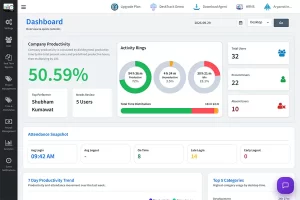
Look at the weekly table. On Saturday, total time is almost 8 hours, but productivity drops to 22% and idle time rises to nearly 6 hours. That is not a reason to punish anyone. It is a reason to ask whether Saturday shifts are worth running.
2. Activity log: apps, websites, window titles and file paths
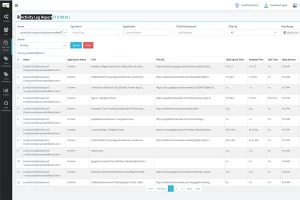
The activity log is the detailed record behind every number. You can filter by person, app, keyword or date. DeskTrack reads window titles and file names, so you know which documents and folders work went into, but it never opens the files. Desky also uses these paths to put time on the right project and client automatically, with no timesheets.
3. Application analytics: which apps the team really uses
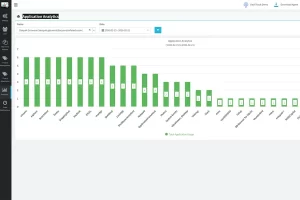
This view answers questions beyond productivity. Are you paying for software nobody opens? Is a remote-access tool like AnyDesk running where it shouldn’t be? More detail on the app usage tracking page.
4. Screenshot monitoring: optional, with a minimum 5-minute interval
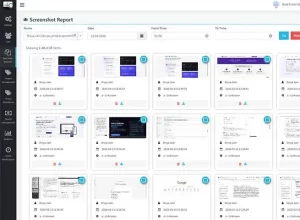
Screenshots are the most sensitive part of computer monitoring, so use them only where you need proof of work, for example client-billed teams or BPO work. You can switch them off for any team. Read more about screenshot monitoring.
5. Idle time, offline work and focus sessions
- Idle time: when the computer is on but not used. See idle time tracking.
- Offline tracking: activity is recorded without internet and synced when the computer reconnects.
- Focus sessions: uninterrupted blocks of work, so you can see deep work, not just activity.
- Alerts: configurable notifications for the events you choose.
- Employee self-view: every employee can see their own day.
Try it on your own computer first
Install DeskTrack on your own PC and look at your own data before you roll it out. Windows, Mac and Linux. 15-day free trial, no credit card.
How to Track Employee Computer Activity With Desky AI
Dashboards are useful, but most owners and CXOs don’t have time to read them. Our founder, Rashmi Singh, used to export DeskTrack data into an AI chat tool before every review meeting and paste it in by hand. During busy weeks, she stopped. So we built Desky, the DeskTrack AI Workforce Agent, directly on your computer activity data.
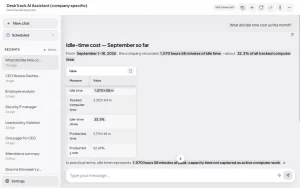
You ask a question in plain English. Desky answers with the numbers and shows how it calculated them. Here is a real answer to “What did idle time cost us this month?“
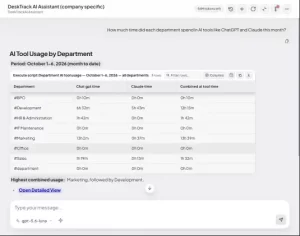
Desky can also review file activity for risk. It looks at file names, folder paths, apps, websites and dates, and flags patterns that may point to credentials or sensitive business data, such as a file name that suggests a password list. It cannot see what is inside a file, where a file was sent or whether the person was allowed to use it. Asked to “Audit credentials and sensitive-data exposure”, it reviewed 28,853 file events and flagged the records worth checking:
Desky will not rate or recommend action on a person from activity data alone. It gives you the facts and the calculation. You decide.
What each leader asks Desky
| Role | What they need from computer activity | Example Desky question |
| CEO / owner | Where paid hours go, without opening a dashboard | Give me a one-page summary for Monday |
| CFO / finance | The cost of idle time and unused software | What did idle time cost us this month? |
| HR | Overwork and attendance patterns | Who worked more than 10% above office hours? |
| IT / security | Unusual file and app activity | Audit sensitive-data file activity this month |
| Project / delivery | Hours by project and client | How many hours went to each client this month? |
Prompts managers save and schedule in Desky
- What did idle time cost us this month?
- Which apps took the most time in each team last week?
- Who worked more than 10% above office hours this week? (burnout check)
- Which employees had productivity below 50% for 2 weeks in a row?
- How many hours went to each project and client this month?
- List file activity flagged as sensitive this week
- Give me a one-page computer activity summary for Monday
Schedule any prompt daily, weekly, monthly or yearly, and Desky sends the answer to your email or WhatsApp. Nobody has to prepare a report. Desky is included in DeskTrack’s Growth plan, not sold as an add-on.
See how Desky works alongside the reports in our employee computer activity monitoring software.
How to Choose a Computer Monitoring Tool: 9 Checks
Most PC monitoring software for business records apps and websites. The real differences are what the tool does with the data and how it treats your employees. Check these nine things:
| Check | Why it matters | DeskTrack |
| Visible mode by default | Builds trust and keeps you on the right side of notice laws | Yes. Silent mode only where law and your policy allow |
| Role-based productivity | One “productive apps” list for everyone is unfair | Yes, with the formula shown |
| Employee self-view | People fix their own habits when they can see them | Yes |
| Clear privacy limits | Keylogging and webcam capture create legal and trust risk | No keystrokes, file contents, webcam or live streaming |
| AI answers, delivered to you | Many AI features wait inside the dashboard | Desky answers questions and sends scheduled briefs to email/WhatsApp |
| Works on every OS | Mixed offices are normal | Windows, Mac, Linux, plus iOS/Android for field staff |
| Easy rollout | A tool nobody installs is useless | Self-install (typically about 5 minutes), or MSI via ManageEngine / Active Directory |
| Security certification | Your activity data is sensitive | ISO 27001 certificate; data encrypted in transit and at rest |
| Transparent price | Hidden pricing usually means a sales call | Per user per month, listed on the pricing page |
If DeskTrack fits that list, the next step is the full feature tour of our PC monitoring software for business. Comparing tools side by side? Our comparison pages show the differences feature by feature.
Is There Free Employee Computer Monitoring Software?
Yes, but read the limits before you install one. Free employee computer monitoring software usually comes in three types:
Built-in OS tools (Windows Event Viewer, macOS Screen Time). Free, but they show one computer at a time, with no team reports and no productivity by role.
- Free plans of paid tools. Usually limited to 1–5 users, with no screenshots, short data history or no reports.
- Open-source or unknown “free” trackers. Your activity data, including URLs and file names, goes somewhere. Check who hosts it and whether they are security certified.
DeskTrack is not free forever. It gives you a 15-day free trial with no credit card. Nothing is charged automatically when the trial ends. That is enough time to monitor your team for two full weeks and decide on real data. After that, pricing is per user per month, and in most businesses it costs far less than the idle time it uncovers. Start with the employee computer monitoring software overview, or go straight to the free trial.
How to Track Computer Usage Without Micromanaging
Computer monitoring helps when it gives managers patterns and gives employees a view of their own day. It hurts when it is used to catch people out. Use it to:
Find where paid hours go, by team, project and client
- Spot overwork early (productivity above 100% for several weeks)
- Prove work to clients you bill by the hour
- Protect sensitive files and check unusual file activity
- Cut unused software licences
Never use computer monitoring to:
- Track people secretly when your law or policy requires notice
- Punish someone for a single idle hour or a short personal break. Set a break allowance in your policy instead
- Expect 100% productivity every day. No human works like that
- Replace a conversation with the employee. Use the data to ask a question, then listen
Conclusion
To monitor employee computer activity well, you need four things: a clear reason, an open policy, role-based measures and a weekly habit of reviewing trends. In our experience, the teams that skip the policy step are the ones most likely to face pushback.
Try it on yourself first. Install DeskTrack on your own computer, look at your data after 5 minutes, then ask Desky your first question.
No Credit Card Required
Know where every paid work hour goes
8,000+ companies registered. 15-day free trial, no credit card, nothing charged automatically..
Related reading: Best computer and laptop tracking software · Advantages and disadvantages of computer tracking software · How to manage remote employees
Frequently Asked Questions
Q. How do I monitor my employees’ computer activity?
Ans. Tell employees what you will track and why, then install a computer monitoring agent such as DeskTrack on company computers. Define productive apps and websites for each role, and review weekly reports of app use, websites, active and idle time and, if enabled, screenshots. Let employees see their own data.
Q. Is it legal to monitor employee computer activity?
Ans. It can be, but it depends on where your employees work. Rules vary by country and state, by who owns the device and by what data you collect. Common requirements are a clear work purpose, advance notice to employees and collecting only what you need. New York, Connecticut and Delaware have specific notice laws, the EU GDPR requires a lawful basis and proportionate monitoring, and India’s DPDP Act duties apply in phases, mostly from May 2027. This is general information, not legal advice; check with a lawyer where your employees work.
Q. What can computer monitoring software see?
Ans. DeskTrack records apps, websites, window titles, file and folder names, active and idle time, and screenshots at an interval you set (minimum 5 minutes). It does not record keystrokes, read file contents, use the webcam, record video or stream screens live.
Q. Can employees tell if their computer is being monitored?
Ans. With DeskTrack, monitoring is visible by default and employees can see their own data. Silent mode exists, but you should use it only where local law and your written policy allow it.
Q. Is there free employee computer monitoring software?
Ans. Built-in OS tools and some free plans exist, but they usually cover one computer or a few users and lack team reports. DeskTrack offers a 15-day free trial with no credit card required.
Q. What should I look for in PC monitoring software for business?
Ans. Look for visible monitoring, role-based productivity, employee self-view, clear privacy limits, support for Windows, Mac and Linux, easy rollout and security certification. DeskTrack covers all of these and adds Desky, an AI agent that answers questions about computer activity and sends scheduled reports by email or WhatsApp.
Q. Does computer monitoring work when employees are offline?
Ans. Yes. DeskTrack records activity without internet and syncs it when the computer reconnects.
Q. How long does it take to set up employee computer monitoring?
Ans. Typically about 5 minutes for one computer: sign up, install the agent and data starts appearing. For company-wide rollouts, IT can push the MSI package through ManageEngine and link users with Active Directory.