Your employees are using ChatGPT, AI assistants, automation tools and other AI-powered applications. Your company may even be investing in AI subscriptions, training and implementation.
But there is one question every business leader should be asking:
Is AI actually making your business better, or are your employees simply using more AI tools?
AI adoption is not the same as business improvement.
An employee can spend hours using AI without completing more work. A department can generate more content without improving its quality. A team can automate individual activities while the overall business process remains slow, disconnected or difficult to manage.
For CEOs, founders and operations leaders, the real challenge is not measuring how much AI is being used. It is understanding whether AI usage is connected to meaningful work, completed tasks, better execution and measurable business outcomes.
This article explores how businesses can measure AI usage, understand departmental differences and connect workforce activity with actual operational execution.
AI adoption is increasing. But how do you know whether it is working?
Most companies are approaching AI adoption through individual employees and departments.
Marketing teams use AI to create content, research markets and prepare campaigns. Sales teams use it for prospect research, emails and proposals. Developers use AI coding assistants. Operations teams experiment with reporting, documentation and workflow automation.
These are useful applications.
However, management often has an incomplete picture:
- Which departments are actively using AI?
- How much time is being spent on AI applications?
- Is AI usage connected to actual business tasks?
- Are employees completing their assigned work?
- Are tasks getting delayed despite increased AI adoption?
- Are managers able to identify where work is getting stuck?
Without this information, AI adoption becomes difficult to evaluate.
The first step is to distinguish three things:
AI activity: What AI applications are being used and for how long?
Work execution: What tasks, projects and responsibilities are being worked on and completed?
Business outcomes: What measurable business results are improving?
These are related, but they are not interchangeable.
AI activity provides visibility into usage. Work execution provides context. Business outcomes tell management whether the overall process is producing the intended result.
What does actual AI usage look like across departments?
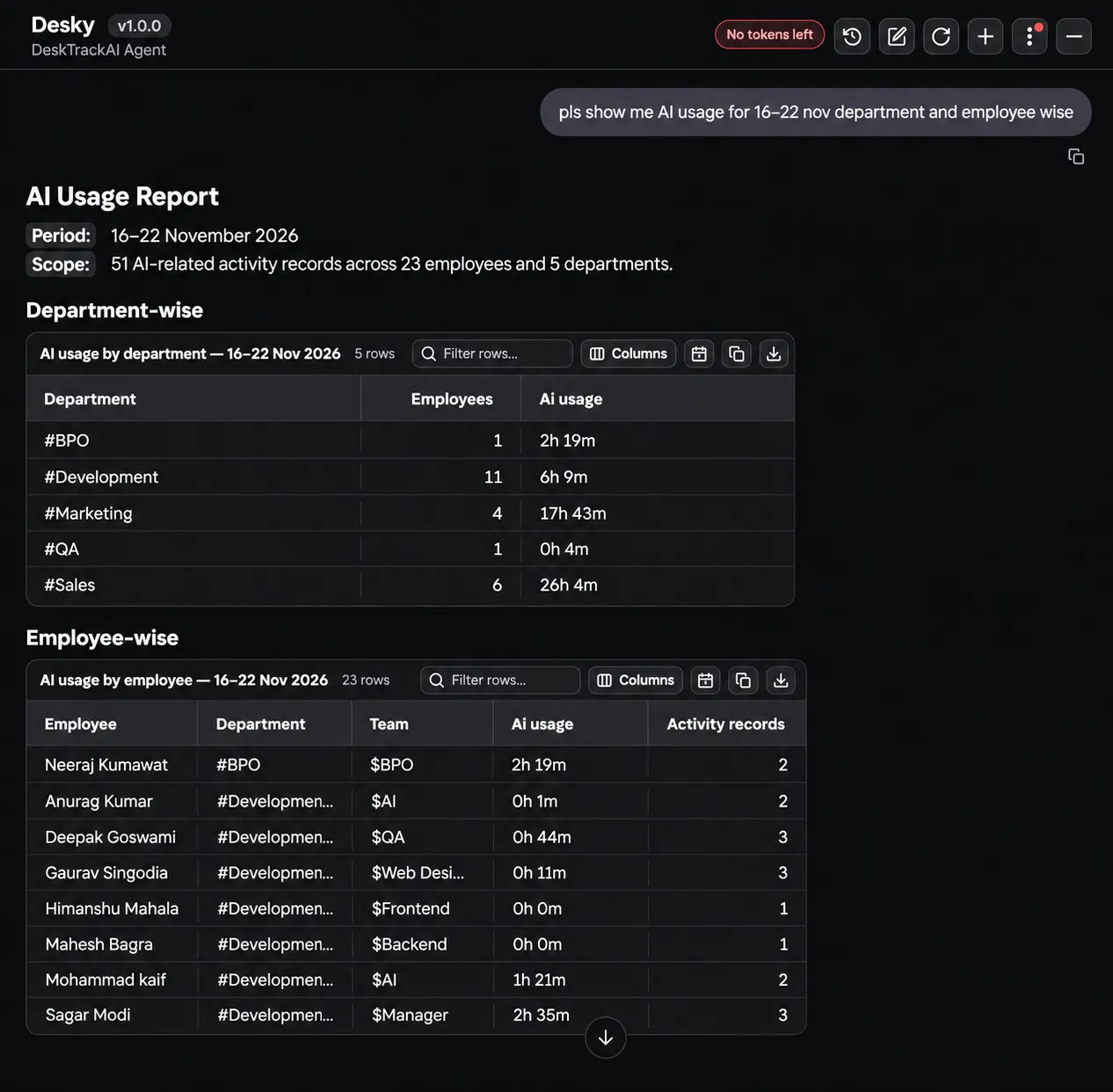
Consider a real internal data review covering 16–22 November 2026.
The review covered 23 employees, five departments and 51 AI activity records.
The departmental comparison showed the following:
| Department | Recorded AI usage | Internally reported productivity metric |
|---|---|---|
| Marketing | 17h 43m | 75.83% |
| Sales | 26h 04m | 47.87% |
| Development | 6h 09m | 72.63% |
These figures raise interesting management questions.
Sales recorded the highest AI usage among the departments shown. However, its internally reported productivity metric was lower than the figures for Marketing and Development.
Does this mean AI is less useful for Sales?
Not necessarily.
The data does not establish that AI usage caused a higher or lower productivity result. Different departments perform different kinds of work, use different applications and have different definitions of completed output.
Sales may spend time researching prospects, preparing proposals, updating CRM records and communicating with customers. Marketing may spend time generating content, analysing campaigns and preparing creative material. Development may use AI tools as part of coding and debugging workflows.
The comparison should therefore be treated as a starting point for investigation, not a performance ranking.
The important question is:
What is each department getting done with the time and tools available to it?
| Department | Employees | AI usage | Average productivity | Productivity records |
|---|---|---|---|---|
| #BPO | 1 | 2h 19m | 53.47% | 1 |
| #Development | 11 | 6h 9m | 72.63% | 11 |
| #Marketing | 4 | 17h 43m | 75.83% | 4 |
| #QA | 1 | 0h 4m | 98.42% | 1 |
| #Sales | 6 | 26h 4m | 47.87% | 6 |
Why AI usage hours alone cannot measure productivity
Imagine two employees.
Employee A spends three hours using AI applications but does not complete the assigned deliverable.
Employee B spends 45 minutes using AI to prepare a useful analysis, completes the task and submits it for review.
Who has made better use of AI?
Usage duration alone cannot answer that question.
AI activity data can help managers understand how frequently employees use AI applications and where usage is concentrated. But it does not automatically establish:
- The quality of the output
- Whether the assigned task was completed
- Whether the work was accurate
- Whether the work created business value
- Whether the employee used the tool effectively
This is why businesses need to connect activity visibility with task and workflow information.
A useful management framework is:
| AI activity | Application usage and time | Where is AI being used? |
|---|---|---|
| Measurement layer | What to examine | Management question |
| Task execution | Assigned, pending and completed tasks | Is work progressing? |
| Work quality | Review, errors and rework | Is the output acceptable? |
| Business outcome | Revenue, delivery, service or cost metrics | Is the business benefiting? |
No single layer gives the complete answer.
The value comes from examining them together.
Is your team using AI while important work remains pending?
This is one of the most important questions for business leaders.
A company may have employees actively using AI while its operational processes still experience:
- Delayed tasks
- Incomplete assignments
- Unclear ownership
- Repeated follow-ups
- Approval bottlenecks
- Poor visibility into project status
AI usage and task completion need to be examined together.
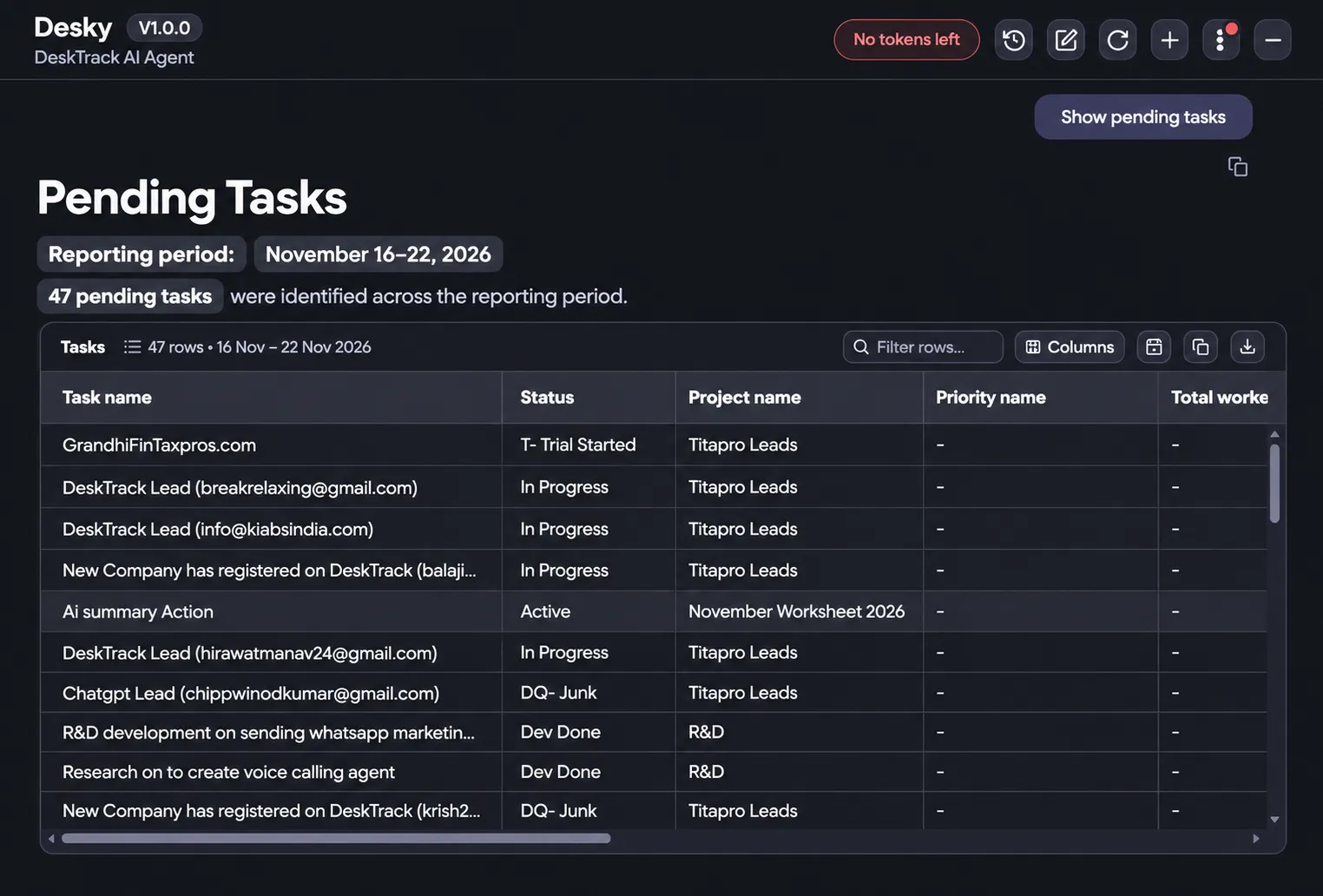
For example, a team member may use AI to prepare a report, but the report may still need review and approval. A sales representative may use AI to draft an email, but the prospect follow-up may remain incomplete. A manager may use AI to prepare a summary, but the underlying action items may not be assigned.
The management problem is not necessarily a lack of AI adoption. It may be a lack of process ownership and follow-through.
How can businesses connect AI usage with actual work?
The next step is to connect the information that usually sits in separate systems.
A practical operating model has three layers:
1. Workforce activity visibility
Understand work-related activity and time allocation.
Questions to examine:
- Which applications are being used?
- When is activity concentrated?
- How is time distributed across work?
- Are there unusual patterns that require investigation?
This is where workforce activity and time-tracking information can help.
2. Task and workflow execution
Understand whether work is moving through the organisation.
Questions to examine:
- What has been assigned?
- What has been completed?
- What remains pending?
- Which tasks are delayed?
- Who owns the next action?
This is where workflow and task-management systems provide context.
3. Management intelligence
Bring the information together to support better questions and decisions.
For example:
- Which departments need additional support?
- Which processes have repeated delays?
- Are employees spending time on work that supports their responsibilities?
- Which workflows should be redesigned?
- Where could automation reduce unnecessary manual steps?
The objective is not to create more dashboards. It is to give managers enough reliable information to investigate problems and take appropriate action.
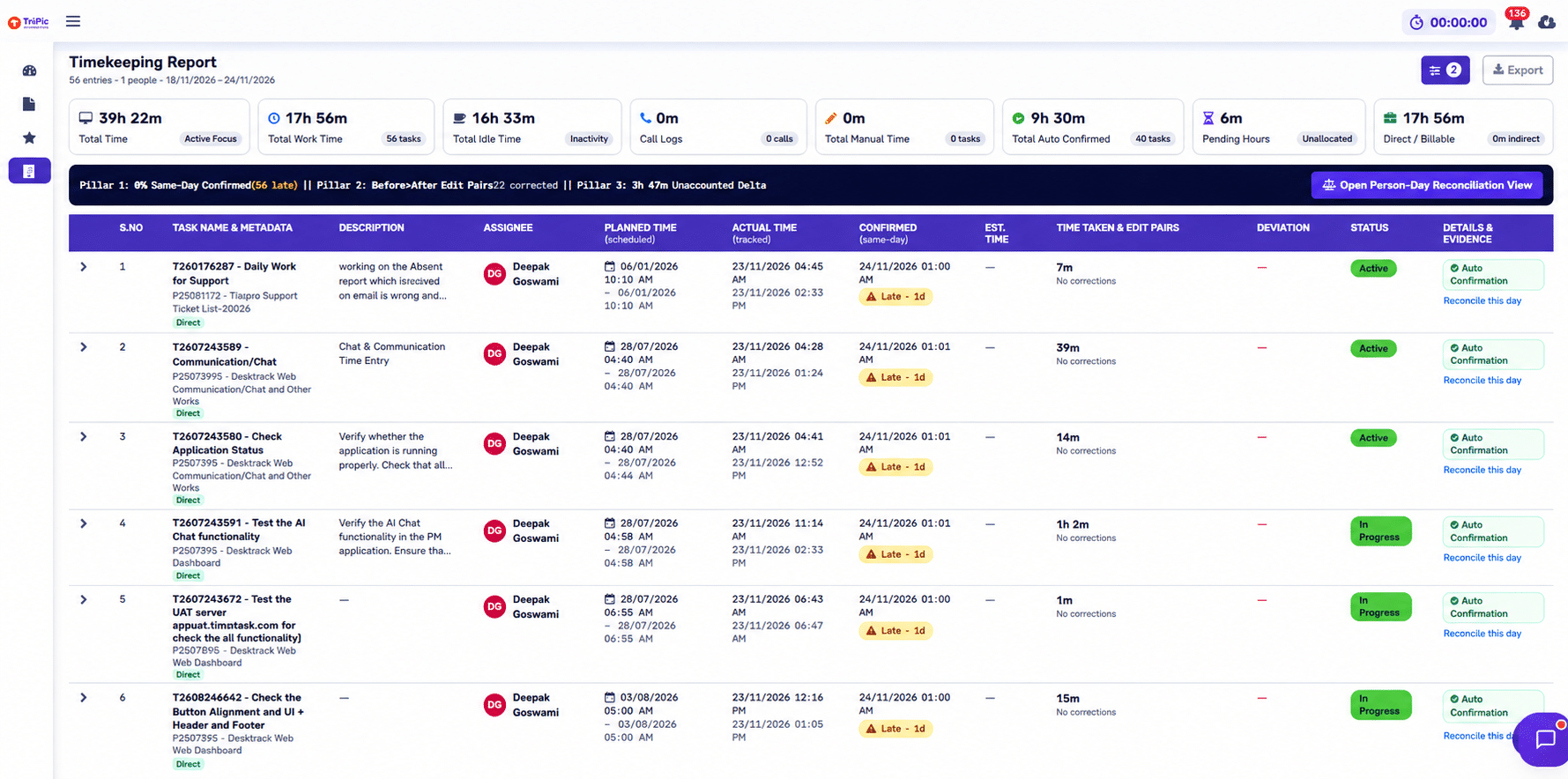
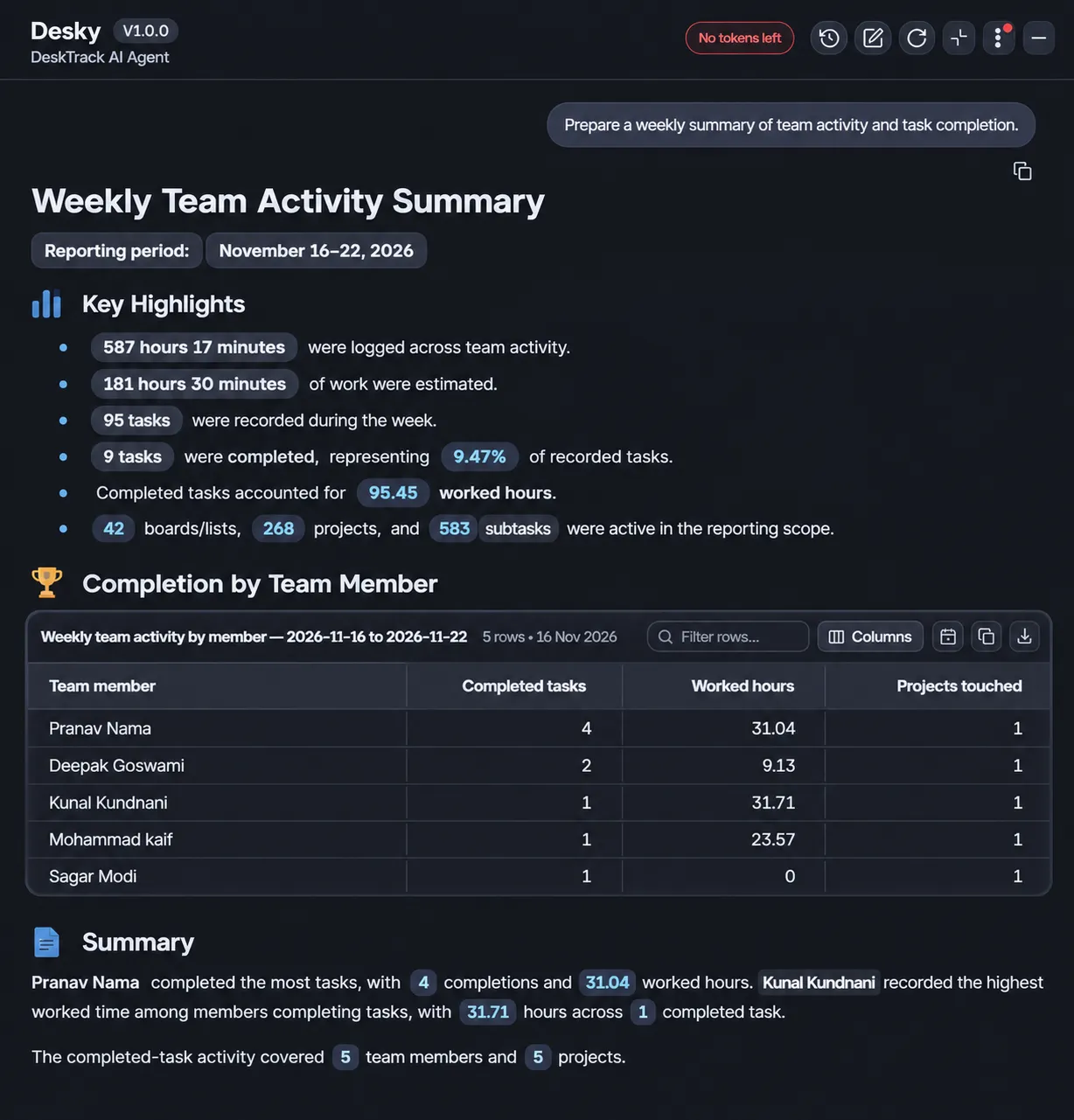
The relevant DeskTrack and TitaPro views that show time records alongside related task or project information.
What should a CEO measure when introducing AI?
A CEO does not need to measure every AI interaction.
The priority is to identify whether AI is helping the business achieve its operational objectives.
Consider these five measurement areas:
| Area | Example metric | Why it matters |
|---|---|---|
| Adoption | Active AI users by department | Shows where AI is being adopted |
| Usage | AI application usage duration | Shows the distribution of usage |
| Execution | Task completion and overdue tasks | Shows whether work is progressing |
| Quality | Error, review and rework rates | Helps assess output reliability |
| Business impact | Process cost, delivery time or conversion | Measures the outcome relevant to the business |
A company should define its own baseline before measuring improvement.
For example, if the objective is to improve customer response times, measure the existing response time before implementing AI. Then compare performance after implementation, while accounting for changes in workload, staffing and other factors.
If the objective is to improve project delivery, examine completion time, delays, quality and customer acceptance rather than relying only on application usage.
How can AI help improve business processes?
Once management understands usage and execution, the next opportunity is process improvement.
Start with the areas that create repeated friction.
Sales: Use AI to support research, communication preparation and reporting. Measure follow-up completion, response times and pipeline outcomes.
Marketing: Use AI for research, content assistance and analysis. Measure content quality, campaign performance and qualified lead generation rather than content volume alone.
Development: Use AI coding assistance where appropriate. Measure code quality, review outcomes, delivery progress and rework.
Operations: Use AI to support reporting, document handling and information retrieval. Measure process completion, errors and delays.
HR and administration: Explore appropriate uses in employee queries, documentation and routine workflows. Preserve human oversight for sensitive employment decisions.
The right use case depends on the task, data quality, process requirements and risk involved.
AI should support people and processes, not become a reason to remove necessary checks or accountability.
What should businesses do next? A practical AI productivity review
A business does not need to redesign its entire operating model to start measuring AI effectiveness.
Begin with a structured review.
Step 1: Identify AI usage.
Understand which departments and employees are using approved AI applications.
Step 2: Identify the work connected to that usage.
Where possible, connect application activity with the relevant tasks, projects or business processes.
Step 3: Review task execution.
Examine completed, pending and delayed work.
Step 4: Evaluate quality.
Check whether the output is accurate, useful and accepted by the relevant reviewer.
Step 5: Measure business impact.
Compare relevant operational metrics against a baseline.
Step 6: Improve the process.
Identify whether the next improvement should be better training, clearer ownership, workflow redesign, automation or a different AI use case.
Repeat the review regularly, but avoid turning AI usage into a simplistic employee ranking system.
The purpose is to improve how the organisation works.
How DeskTrack and TitaPro fit into this picture
Businesses need more than an AI application usage report to understand how work is progressing.
DeskTrack provides workforce time and activity visibility. This can help organisations understand application usage and time allocation.
TitaPro provides a workflow and operating platform for organising tasks and business processes.
Tita AI can provide conversational access to relevant task and workflow information, including summaries and reports where supported by the configured system.
Together, these capabilities address different parts of the management question:
- What activity is taking place?
- What work has been assigned?
- What has been completed?
- What remains pending?
- What needs management attention?
They do not automatically prove that AI has improved productivity or business performance. Those conclusions require appropriate baselines, outcome measures and human review.
Explore DeskTrack workforce visibility and the TitaPro workflow platform to understand how these parts of business operations can be organised.
For more information about AI-assisted workforce reporting, see Desky AI.
Conclusion: Stop measuring AI adoption alone. Start measuring business execution.
Your employees may be using AI every day. Your business may have invested in multiple AI tools. But neither fact guarantees better performance.
The real question is whether AI is helping people complete the right work, improve processes and contribute to measurable business outcomes.
Start by understanding AI usage. Connect it with task execution. Review quality. Measure outcomes. Then improve the processes where the evidence shows an opportunity.
AI adoption tells you that people are using technology. Business execution tells you whether the organisation is moving forward.
The goal should not be to make employees use more AI. It should be to build a business where people, processes and technology work together more effectively.
Frequently asked questions
Q. How do you measure AI productivity in a business?
Measure AI adoption and application usage alongside task completion, output quality, process time and relevant business outcomes. AI usage duration alone is not a measure of productivity.
Q. Does more AI usage mean higher employee productivity?
No. More AI usage does not automatically mean higher productivity. The usefulness of the work, task completion, output quality and business context all matter.
Q. How can CEOs monitor AI adoption across departments?
CEOs can review approved AI application usage by department, examine the work connected to that activity and compare it with task execution and relevant business metrics. They should also consider differences in departmental responsibilities.
Q. What is the difference between AI adoption and AI productivity?
AI adoption describes whether people and teams are using AI. AI productivity concerns whether that usage contributes to better work outcomes, such as improved quality, reduced process time or more effective task completion.
Q. Can employee monitoring software measure AI productivity?
Employee monitoring and activity tools can provide information about application usage and work-related activity. They cannot independently establish the quality or business value of an employee’s output. Task, quality and outcome information is also required.
Q. How can businesses connect AI usage with task management?
Businesses can connect relevant activity and time records with task or project context, where the systems support that relationship. This helps managers investigate how work is progressing without assuming that application activity equals completed output.
Q. What should a business automate first?
Start with a frequent, well-understood process that has clear ownership and measurable friction. Review whether simple workflow automation or AI-assisted processing is the appropriate solution before introducing more complex agents.
Q. How often should a company review AI usage?
A weekly or monthly review may be useful depending on the nature of the work. The review should focus on patterns, process issues and outcomes rather than simply increasing usage targets.