Manual daily reporting is one of those things that sounds simple but quietly destroys hours of team productivity every week. Employees spend 20–30 minutes writing reports they don’t enjoy writing. Managers spend just as long reading them — often only to realize the information is incomplete, late, or impossible to act on.
There’s a better way. Automated daily activity reports replace the guesswork with real data. No chasing, no copy-pasting, no “I forgot to log that.” Just accurate, real-time insight into exactly how your team spends their day — delivered automatically.
In this guide, we’ll walk through what they are, why they matter, and how tools like DeskTrack’s employee monitoring software make the whole process effortless.
What are Automated Daily Activity Reports?
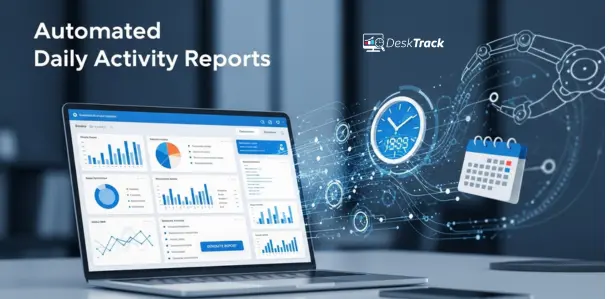
An automated daily activity report is a system-generated summary of an employee’s work activity for a given day — including login/logout times, apps used, websites visited, tasks completed, and idle periods — produced automatically without manual input.
Think of it as a digital work diary that writes itself. Unlike a manual report where an employee types out what they did, automated reporting software silently captures activity data in the background and compiles it into a clean, structured report.
These reports typically include:
- Exact shift start and end times
- Total active vs. idle hours
- Application and website usage breakdown
- Task and project time allocation
- Screenshots (timestamped, at configurable intervals)
- Productivity scores and trends
The result? A complete, tamper-proof record of each employee’s workday — with zero effort required from either the employee or the manager.
This ensures a balance between accountability and privacy.
Why Businesses Need Automated Activity Reporting
Here’s a hard truth: Gartner research consistently shows that visibility into workforce activity is one of the top challenges for business leaders — especially those managing hybrid or remote teams.
When you can’t see how your team works, you can’t improve it. Automated reporting solves exactly that.
| Metric | Value |
|---|---|
| Average time lost per employee per week to untracked work | 3hrs |
| Percentage of managers say manual reports don’t reflect actual work done | 68% |
| Performance review speed increase with automated activity data | 2× |
Beyond numbers, the business value is real:
- You know who’s productive and who needs support — before a deadline slips
- Payroll and billing become accurate and dispute-free
- Remote teams feel accountable without feeling surveilled
- Managers spend time leading instead of chasing status updates
- You build a data-driven culture instead of a “trust me” culture
The Real Problems with Manual Daily Reports
If you still rely on manual employee daily activity reporting, you’re likely dealing with at least a few of these pain points every week:
| Problem | Impact |
|---|---|
| Reports submitted late or not at all | Blind spots in daily progress. No data for reviews. |
| Inflated or estimated hours | Payroll inaccuracies. Client billing disputes. |
| Incomplete task details | Managers can’t gauge actual output or blockers. |
| Time wasted writing reports | 30+ min/day per employee — that’s 2.5 hrs/week per person. |
| No standardized format | Impossible to compare or analyze across teams. |
Manual reporting also creates a psychological burden. Employees feel like they’re being asked to prove themselves, while managers feel like they’re acting as report-chasers rather than leaders. Nobody wins.
Key Features of Daily Activity Log Software
Not all daily activity log software is created equal. When evaluating options, here are the features that actually move the needle:
| Feature | Description |
|---|---|
| Automatic Time Capture | Logs start/end times and work sessions without any employee input. Works in the background silently. |
| App & URL Tracking | Records which applications and websites employees use — and for how long — each day. |
| Screenshot Monitoring | Captures periodic screenshots as visual proof of work — configurable frequency, fully audit-ready. |
| Idle Time Detection | Flags inactive periods so you can distinguish genuine focused work from screen-open-but-idle time. |
| Productivity Scoring | Automatically categorizes activity as productive or unproductive, generating daily scores. |
| Auto-Generated Reports | Scheduled reports land in your inbox daily — no clicks, no manual compilation required. |
| Project-Level Tracking | Ties time and activity logs to specific projects or clients for accurate billing and resource planning. |
| Alerts & Anomaly Detection | Get notified when unusual activity happens — like data transfers outside business hours. |
How Automated Reporting Improves Productivity
It might sound counterintuitive: how does tracking someone make them more productive? The answer lies in awareness and accountability — not surveillance.
1. Awareness Drives Self-Improvement
When employees can see their own activity reports, they naturally course-correct. Seeing “2.5 hours on non-work sites today” is far more motivating than a manager lecture. Employee productivity monitoring creates a feedback loop that encourages better habits organically.
2. Managers Make Better Decisions
Instead of relying on gut feel or weekly standups, managers get daily data: who’s at capacity, who’s underutilized, and where bottlenecks are forming. That means better task allocation, better deadlines, and better outcomes.
3. Meetings Get Shorter (or Disappear)
How many of your meetings exist just to answer “what did everyone work on?” With automated daily logs, that question has a real answer — available anytime. You don’t need a meeting to review what the report already shows.
4. Performance Reviews Become Evidence-Based
Instead of relying on memory or subjective impressions, reviews are grounded in months of accurate activity data. Employees appreciate the fairness. Managers appreciate the clarity. HR appreciates the documentation.
According to Forbes, companies that implement structured activity monitoring report measurable gains in output quality and a reduction in time lost to non-work activities — particularly in remote-first environments.
Your Team is Working … But Do You Have Proof?
Get complete transparency with automated daily activity tracking.
💼 Perfect for remote & hybrid teams
📊 Data-driven decisions made easy
How DeskTrack Helps with Daily Activity Monitoring
DeskTrack is built specifically for this problem. It’s not a generic project management tool that happens to have a timer — it’s a dedicated daily activity software platform designed to give businesses complete visibility without adding friction to anyone’s day.
Here’s what makes DeskTrack different:
- Automatic time tracking software that runs silently in the background — no timers to start, no forms to fill
- Real-time application usage tracking that categorizes every app and URL as productive or unproductive
- Configurable time tracking with screenshots for complete visual proof of work
- Instant access to employee daily activity monitoring dashboards — for individuals, teams, and departments
- Scheduled daily email reports delivered to managers automatically — no login required
- Attendance, idle time, and shift reports all in one place
- Data export and integration with payroll for seamless billing
And because DeskTrack runs on desktop (Windows & Mac), it captures actual computer-based work — not just what employees remember to log.
Who Benefits Most? Real-World Use Cases
| Industry | Description |
|---|---|
| Remote & Hybrid Teams | Automated reports fill the visibility gap for performance tracking without micromanaging. |
| Digital Agencies & Creative Studios | Automated daily reports ensure billing accuracy and tracking of project allocations. |
| IT Companies & Development Teams | Application usage tracking captures time spent across various tools, aiding in sprint planning. |
| BPO / Call Centers | Automated reporting delivers metrics on shift adherence, productivity, and compliance. |
| Legal, Finance & Compliance-Heavy Industries | Detailed activity logs serve as audit trails for billing and regulatory documentation. |
How to Choose the Right Activity Reporting Tool
The market has dozens of options. Here’s a practical checklist to cut through the noise:
Must-Have Features
- Fully automated capture — no manual timers or forms
- App + URL tracking with productivity categorization
- Screenshot capability with configurable frequency
- Scheduled report delivery (daily/weekly to email)
- Idle time and shift time detection
- Individual + team-level reporting views
Nice-to-Haves
- Project and task-level time allocation
- Payroll and invoicing integration
- Mobile app for field employee tracking
- Role-based access control for multi-manager setups
- Data export in CSV/Excel
Watch Out For
- Tools that require employees to manually start timers (defeats the purpose)
- Pricing that charges per report or feature instead of per user
- Poor data security or unclear privacy policies
- No free trial — you should always test before committing
DeskTrack checks every box on the must-have list and most of the nice-to-haves. With a 15-day free trial and no credit card required, it’s easy to test drive with your actual team before deciding.
According to HubSpot’s business productivity research, organizations that implement structured time and activity tracking tools see an average 23% improvement in on-time project delivery. The right tool pays for itself quickly.
This ensures a balance between accountability and privacy.
Manual Reporting vs. Automated Reporting: A Side-by-Side Look
| Feature | Manual Reports | Automated Reports (DeskTrack) |
|---|---|---|
| Time to generate | 20–45 min/day per employee | Zero — auto-generated |
| Accuracy | Relies on memory, prone to estimates | System-captured, exact to the second |
| Completeness | Often missing app/URL data | Full activity breakdown included |
| Timeliness | Late submissions common | Available in real-time, always |
| Manipulation risk | High — easy to inflate hours | None — system data can’t be faked |
| Manager time to review | 30–60 min for a team of 10 | 5 min with visual dashboard |
| Historical data analysis | Scattered across emails/sheets | Searchable, filterable, exportable |
Frequently Asked Questions (FAQ)
Ans. A daily activity report for employees is a structured record of what an employee worked on during a given workday — including hours logged, tasks completed, applications used, and time allocation across projects. When automated, this report is generated by software without any manual input, ensuring accuracy and consistency across your entire team. Ans. Automated activity reporting software runs silently in the background on an employee’s computer. It captures login/logout times, records which applications and websites are used, detects idle periods, and optionally takes periodic screenshots. All this data is compiled into a structured daily report and delivered to managers — either via a dashboard or scheduled email — without any manual steps. Ans. The best daily activity log software should automatically capture time, apps, URLs, and idle periods without requiring manual input from employees. DeskTrack is a leading option that combines automatic time tracking, screenshot monitoring, productivity scoring, and scheduled report delivery in one platform — with a 15-day free trial available. Other options include Hubstaff, Time Doctor, and Teramind, but DeskTrack is particularly strong for teams needing detailed daily reports with minimal setup. Ans. Employee activity monitoring is important because it gives managers objective insight into how work time is actually being spent — not just how employees remember or describe it. This enables fair performance evaluation, accurate billing, better resource planning, and early identification of productivity issues before they become bigger problems. When implemented transparently, it also helps employees self-manage more effectively. Ans. In most countries, tracking employee activity on company-owned devices during work hours is legal — particularly when employees are informed about it. Ethical implementation involves clear communication about what is tracked, why, and how the data is used. DeskTrack supports both silent (background) and visible (employee-aware) monitoring modes, and operates in compliance with standard workplace privacy guidelines. Always consult your local employment laws for specifics in your region.activity-reports