Presuming that you are a business person or team lead, you have many obvious and important things to keep tabs on. Likewise, there are many oblivious things as well. For instance, the average working days in a month. You couldn’t care less about them. However, we guarantee that after going through this blog, you will start more than caring about the number of weekly, monthly, and yearly working days.
What is a Working Day?
A working day is a weekday when you expect your employees to work. This day lasts between clock in and clock out, which is commonly 9:00 AM to 5:00 PM, which is 8 hours, which is a requirement to complete the minimum 40 weekly work hours according to the FLSA, given that there are 5 standard work days in a week. Did you know that out of the 365 days in a year, there are only 260 working days due to weekends, holidays, etc?
How Many Work Hours in a Day?
As we mentioned before, a working day is usually 8 hours, which is commonly 9:00 AM to 5:00 PM. Assuming that you provide your employees with at least an hour lunch break and 1 or 2 short breaks in between, it is always more than 8 hours. However, it depends on your business and industry. Armed with this information, let’s look at the average working day according to the most common work arrangements.
- The Nine-to-Five Workday: It’s just a fancy term for the traditional continuous 8-hour work schedule. Speaking from experience, it’s never 9:00 AM to 5:00 PM. Here, providing lunch breaks is completely up to the organization.
- A Complete 24-Hour Bracket: Businesses and organizations with flexible work hours experience the 24-hour workday. To give you an instance, a manufacturing business runs all year long due to continuous product demands from customers. So, they use rotating shifts or shifts like the DuPont shift schedule to ensure 24/7 employee availability while maintaining work-life balance.
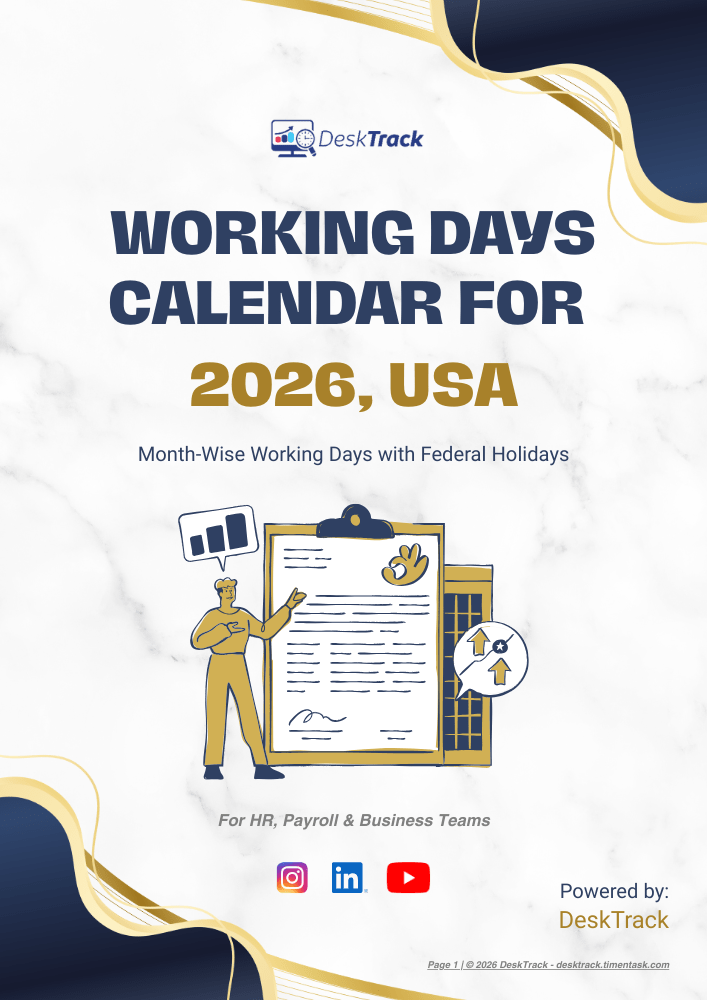
Working Days Calendar 2026 – USA
Download this accurate and reliable 2026 Working Days Calendar (USA) to plan smarter and stay ahead.
| DeskTrack Fact |
| Did you know that some states in the USA mandate employers to pay higher rates to employees working overtime? For example, the overtime mark in California and Nevada is any hour past 8 hours, while in Colorado, it’s 12 hours. |
Read Also: Payroll Management Software for Faster & Accurate Payroll Processing
What is a Working Week?
A working week consists of all the days employees work in a week. Usually, it’s the whole week minus Saturday and Sunday, which is the weekend. Thus, a workweek is typically 5 days in the USA, spanning at least 40 hours, which is mandatory according to the FLSA. However, this is where it gets complicated. Don’t forget that you also have to account for the 11 federal holidays and other holidays such as Good Friday, assuming that you are providing complimentary time off on these days. For instances
- If Christmas falls on a weekday, you will have a 4-day workweek.
- During peak seasons, you might have to call in your staff to work on weekends. This can span a 6 or even 7-day workweek for your employees.
| DeskTrack |
| Did you know that your employees are eligible for double time, overtime, or double time and a half in case they work on a designated holiday? |
Working Week Vs Calendar Week
It’s pretty simple to differentiate between working and calendar weeks:
| The working week consists of all the days your employees work. Typically, it’s 5 days. However, in certain situations, it can also be 6-7 days or just 3-4 days. |
| A calendar week consists of the workweek with the weekend. Simply put, it spans the 7 days from Monday to Sunday. |
Exception: Night shifts span 2 days, i.e., the night of day 1 and the morning of day 2. Here, it’s smart to specify the rules for dividing the work hours accordingly. This is to ensure that you fairly pay your workers for their hard work.
What is a Working Month?
A working month consists of all the workweeks in a month. Typically, a month will have 4 to 5 workweeks, which is a significant factor for calculating the average number of workdays in a month.
Working Month Vs Calendar Month
Just like differentiating between a calendar week and a working week is simple, knowing how a working month is different from a month in a calendar year is also pretty straightforward:
| A working month consists of all the days employees worked in the 30-31-day month or February, excluding holidays and weekends. We can also assume that there are 4-5 workweeks in a month. |
| A calendar month spans all the days of a month, including holidays and weekends. An average month in a calendar year spans at least 28 days and at most 31 days. |
Don’t miss out on optimizing your 2026 workforce planning.
Discover how DeskTrack can transform your workforce management. Start your free trial today and experience real-time insights, improved efficiency, and accurate payroll calculations.
How Many Average Working Days in a Month?
To identify the number of average work days in a month, we will need a simple formula:
- Working Month Days = Total Days – Weekends – Holidays
- For January, it will be 21 = 31 – 8 – 2.
That’s because you also need to account for the federal holidays. In January, there are 2 public holidays in the USA every year, which are New Year and Martin Luther King Jr Day. Since January has 4 weeks, there will be 8 (4 Sundays and 4 Saturdays) weekends, which we subtracted from the total days in January, which are 31, to get 21 working days. Here are a few more things to consider to get the average number of working days in a month.
- February has 28 or 29 days. So, on average, it will always have 20 working days or fewer.
- The months with 4 weeks will have 21 working days, while the months having 5 weeks will have 22 working days.
- A month can also span as many as 23 working days. This commonly occurs in March and August, which have 31 days and no holidays.
So the average business days in a month will be 20-22, spanning 160-176 work hours. However, this is only applicable for employees who work 8 hours a day full-time, which is 40 hours a week.
Read Also: Top 10 Team Collaboration Tools for Remote Teams in 2026
How to Calculate the Average Number of Working Days in a Month?
How many work days are in a month? So far, we already know one way to calculate the average business days in a month. However, there are also a few more assumptions, which you can consider:
- 52 * 5 / 12 = 21.7: This formula works on the assumption that there are 52 annual weeks. What we did here was multiply it by the 5 weekly workdays and divide it by the 12 yearly months.
- 4 * 5 = 20: We assumed that there are 4 monthly workweeks and then multiplied them by the number of workdays per week, which are 5, simplifying the calculation. However, most months have more than 4 full workweeks.
- 31 – 4 * 2 = 23: Here, we assumed that there are 31 days in a month with 4 full weekends. We subtracted the two to get the average number of monthly workdays. The interesting part here is that the assumptions we made are variables in the real world. To give you an instance, most people believe that 5 full weekends in a month are once or twice in a blue moon, so to be on the safe side, presume 4 monthly weekends. However, 5 full weekends happen more times than you think per year.
💼 Payroll & Overtime Calculator
How to Calculate the Exact Number of Working Days in a Month?
To calculate the exact number of working days in a month, you need to have a calendar. Then, you need to follow these steps.
- Identify the total days, holidays, and weekends for that month.
- Use the first formula given in this blog. I.e., subtract the total weekends and holidays from the days in the month.
However, manually doing it for each month is time-consuming. Plus, there are other factors as well, such as night shifts, irregular shifts, leaves, sabbaticals, flexible working hours, employment type, and working on holidays that can affect the calculations. Also, don’t forget that pinning this data down to a specific employee is complex and frustrating. Instead, use an employee scheduling software to configure shifts faster, more accurately, and efficiently. Trust us, it will take you just half an hour at max to schedule employees this way.
Why Does the Average Working Days in a Month Matter?
In 2 words, accurate payroll, especially if you are doing it manually with timesheets. However, even if you are using the best payroll software, knowing the work days in a month will help you double-check your calculations. It’s much better than to underpay your hardworking employees.
Factors that Can Change the Number of Working Days in a Month
So far, we know that the average working days in a month is 20-22 (or 23 sometimes). However, this assumption can quickly change due to several factors, which you can easily account for with your real-time attendance monitoring software.
1. Holidays
Holidays colliding with weekends will not affect the work days in a month. However, if 1 or 2 of these days fall on a weekday, then it will reduce the number of working days in a month. For example, February has the fewest working days, which are 19 or 20, given that it has 8 weekends and 1 federal holiday.
2. Sabbatical & Leaves
This is specific to particular employees only, assuming that your entire staff taking a leave on the same day in a month will never happen. So, let’s say, employee X has 21 standard working days in a month. However, they also take 5 PTOs, then they will have 16 work days for that month. In case of a sabbatical, they will have 0 working days in a month.
3. Shift & Irregular Work Schedules
This is where calculations can get complicated. That’s why it’s smart to use time tracking software to log the exact work hours. Simply put, night shift, rotating shift, and other irregular employees might take more than a weekday to complete 8 hours. Calculating weekends for such employees is also a complicated task. Because for such employees, there can be 3 weekends: Friday, Saturday, and Sunday, because they completed their required 40 hours within 4 days, or no weekends at all, which accounts for overtime.
4. Flexible Working Hours
Flexible working hours are available for those employees who need more time with their family and friends, for example, students and employees with a sick family member. Calculating the days it will take them to complete their standard 8 hours is also complicated. For example, such employees might work double shifts.
5. Seasonal, Contract & Part-Time Employment
Calculating average working days in a month for seasonal, contract, and part-time employees is not complicated. However, it is simply a little different. For example:
- These employees can work 6 or 7 days in a workweek, depending on the requirements, so the calendar and working month can be the same for them, i.e., spanning 31 days.
- Part-time employees don’t even complete a full 8-hour shift sometimes.
To make your calculations simple here, calculate the work hours first, then convert them to working days. A standard assumption is that 8 hours = 1 working day.
6. Holiday Work
Similarly, when you make your employees work on weekends or holidays, the average work days in a month can change for them. However, let us remind you that in such cases, they qualify for double time, overtime, or double time and a half. So good luck with that.

How Many Average Working Days Are in a Year?
The average working hours in a year are 2080 or 260 work days. Again, this is based on the assumption that there are:
- 5 standard work days in a week
- There are 52 weeks in a year.
- Each workday spans a minimum of 8 hours, excluding lunch, in-between, and coffee breaks.
- Each workweek spans at least 40 hours, excluding weekends and assuming that federal holidays don’t collide with weekdays.
However, in the real world, no employee completes 2080 work hours or 260 working days in a year. Don’t forget, employees have their personal requirements as well, so they will take PTOs and sabbaticals to fulfill those needs.
Make Your Work Days More Productive with DeskTrack
Now that you know the average working days in a month, week, and year, your payroll calculations and processing will be easy and precise in a way. However, how will you ensure that your employees are deserving of the salary and benefits you pay them? You need to get the expected RoI out of the investment you made in your human resources. That’s where DeskTrack’s employee monitoring software comes in. It monitors how much work your employees are doing and the efforts they are putting in, and shows you in real-time with insightful reports. Overall, DeskTrack tells you the reason behind project delays with scalable and customizable features, such as screenshot monitoring, project management, productivity monitoring, and KPI configurations. Try now and realize why 100000+ users around the world have implemented it already.
Frequently Asked Questions (FAQ)
how-many-working-days-in-a-month
Ans. A working day is a weekday when you expect your employees to work. This day lasts between clock in and clock out, which is commonly 9:00 AM to 5:00 PM, which is 8 hours, which is a requirement to complete the minimum 40 weekly work hours according to the FLSA, given that there are 5 standard work days in a week.
Ans. Assuming that Saturdays and Sundays are weekends, the answer to how many weekdays in a month is 5. However, in some countries, such as India, there can also be 6 weekdays depending on business policy. Also, you need to know that only the weekdays when employees work are called working days.
Ans. Follow these steps to get the exact working days for each month.
- Get a calendar
- Identify the total days, holidays, and weekends for that month.
- Subtract the total weekends and holidays from the days in the month.
- Repeat steps 1-3 for each month.
Ans. Use this formula:
- Working Month Days = Total Days – Weekends – Holidays
- For January, it will be 21 = 31 – 8 – 2.
Ans. No, according to the FLSA, Saturdays are considered weekends.
Ans. So far, we know that the average working days in a month is 20-22 (or 23 sometimes). However, this assumption can quickly change due to several factors:
- Holidays
- Sabbatical & Leaves
- Shift & Irregular Work Schedules
- Flexible Working Hours
- Seasonal, Contract & Part-Time Employment
- Holiday Work
Ans.The average working hours in a year are 2080 or 260 work days.