Every small or mid-sized business that works with remote employees, freelancers, or offshore contractors runs into the same quiet problem: the timesheet lands in your inbox on Friday, the hours look reasonable, and you approve it because what else can you do? You weren’t watching. You have no way to verify that the 38 hours logged were actually spent on your project.
This is where Evidence-Based Time Tracking can make a difference. It helps businesses move beyond relying solely on self-reported timesheets and gain better visibility into how work hours are actually being spent.
This isn’t a trust issue. It’s a visibility issue. And it’s costing businesses far more than most owners realize.
| Quick Answer
Evidence-based time tracking is a time-logging method where every recorded hour is backed by verifiable proof screenshots, active URLs, or app activity instead of relying on self-reported numbers alone. It solves timesheet fraud by making every hour auditable, not just claimed. Businesses using it (such as with DeskTrack’s Activity Review) report faster manager review, fewer invoice disputes, and recovered payroll losses that otherwise average 5% of gross payroll annually. |
Key Takeaways
- S. businesses lose up to 5% of gross annual payroll to time theft (American Payroll Association).
- 75% of U.S. businesses experience some form of time theft, most commonly buddy punching.
- Evidence-based time tracking attaches proof screenshots, URLs, app activity to every logged hour, unlike standard timesheets.
- Employees are more accepting of monitoring, not less, when it’s transparent and they can see their own data.
- Tools like DeskTrack automate this evidence-collection so managers don’t have to manually audit timesheets.
What is Evidence-Based Time Tracking?
Evidence-based time tracking is a method of logging work hours where every entry is backed by verifiable proof screenshots, active URLs, or app activity instead of relying purely on self-reported numbers. Unlike traditional timesheets, which record only a start time, end time, and total, evidence-based systems attach documentation to each block of time, so managers can confirm what was actually worked on, not just how long a timer ran.
DeskTrack is one example of a platform built around this model: its Activity Review feature auto-tags each tracked block of time to a real task, attaches supporting evidence, and lets managers confirm hours in a weekly review rather than approving a raw number on faith.
Time Theft Statistics Every Business Owner Should Know
U.S. businesses lose up to 5% of their gross annual payroll to time theft every year, according to the American Payroll Association. On a $1 million payroll, that’s $50,000 quietly disappearing. On a $2 million payroll, it’s $100,000 often enough to hire two additional full-time employees.
Other data points paint the same picture from different angles:
- Roughly 75% of U.S. businesses experience some form of time theft, most commonly buddy punching, where one employee clocks in for another.
- Close to a quarter of employees admit to inflating their reported hours, adding an average of 4.5 extra hours a week that were never actually worked.
- Manual and rounding-based timesheet systems inflate payroll by as much as 22%, simply because “close enough” hours get rounded in the employee’s favor.
None of this necessarily means your team is dishonest. Most of it comes down to a simpler explanation: when a system relies on self-reported hours with no supporting evidence, small inaccuracies creep in and they compound fast across a team.
Are you paying for hours you can’t verify?
See how evidence-based time tracking turns every logged hour into a verifiable record..
How Timesheet Fraud Hits Small Businesses Harder?
Large enterprises can absorb inefficiency. They have compliance teams, dedicated payroll auditors, and margin to spare. Small and mid-sized businesses don’t have that luxury. A few unverified hours per contractor per week doesn’t just mean lost money it means:
- Manager time lost to manual review. Someone has to cross-check timesheets against Slack messages, emails, and project boards, hoping the story adds up.
- Disputed invoices. When a client questions a contractor’s hours and there’s no evidence to point to, both sides lose time and trust resolving it.
- Budget overruns that go unnoticed. Project costs creep upward because nobody can pinpoint exactly where the hours went.
For a lean team without a dedicated operations department, this friction adds up to real, recurring overhead the kind that’s easy to overlook until you actually total it up.
Interestingly, Employees Don’t Mind If It’s Transparent
There’s a common assumption that tighter tracking creates resentment. The data says otherwise, provided the approach is transparent rather than invasive. Employees consistently report far less concern about monitoring when employers are upfront about what’s being tracked and why. Tools that give employees visibility into their own activity data rather than hiding it from them tend to build accountability without damaging trust. The problem was never tracking itself. It was tracking without transparency, and monitoring without evidence either side could actually see.
This is the gap that evidence-based time tracking is built to close.
How Contractor Time Tracking Software With Proof Actually Works
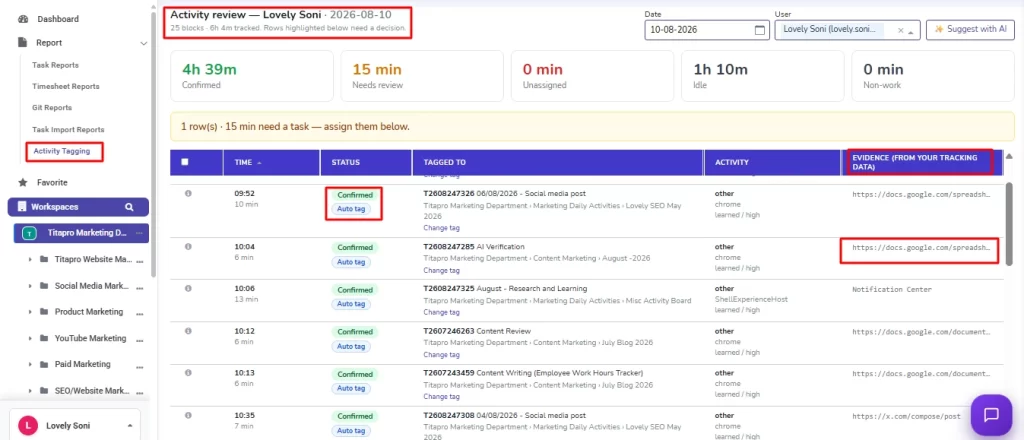
Most time tracking tools stop at a number: “X hours logged.” That number alone tells you nothing about what was actually done. Evidence-based tracking goes a layer deeper it attaches proof to every block of time, so both the business and the contractor are looking at the same facts instead of taking each other’s word for it.
In practice, this looks like:
- Auto-tagged activity – Every tracked block of time is automatically mapped to a real task or project, instead of sitting as an unlabeled chunk of hours.
- Attached evidence – Screenshots, active URLs, and application usage are logged alongside each entry, so a manager can see exactly what was being worked on not just how long the timer ran.
- A clear weekly breakdown – Confirmed hours, idle time, and non-work time are separated out, instead of blended into one ambiguous total.
- A review-and-confirm workflow – Rather than blindly trusting a submitted sheet, managers can review evidence and mark hours as confirmed turning a leap of faith into a two-minute check.
This is precisely the model behind tools like DeskTrack’s Activity Review, where a contractor’s weekly report doesn’t just list hours it shows the actual task, the tagged project, and a piece of evidence for every entry. A manager doesn’t have to ask “did you really work on this?” The report already answers that question.
The Business Case, Beyond Trust
It’s tempting to file this under “nice to have” a way to make timesheets feel more legitimate. But the actual business case is more concrete than that:
- It removes the manual audit burden – When evidence is attached automatically, managers aren’t spending hours each week reconstructing what happened from memory or chat logs. Review becomes a quick scan, not an investigation.
- It kills invoice disputes before they start – A contractor invoice backed by tagged tasks and evidence is far harder to contest and far easier to approve without back-and-forth.
- It protects margin on fixed-price and hourly contracts alike – Whether you’re paying by the hour or managing a fixed-scope project, knowing exactly where time went protects your budget from silent overruns.
- It scales without adding headcount – A five-person operations team can’t manually audit fifty contractors’ timesheets every week. Automated evidence collection can.
- It builds trust in both directions – Contractors who know their work is fairly and accurately represented don’t have to argue for hours they’ve already worked. Businesses don’t have to wonder if they’re being shorted. Everyone is looking at the same evidence.
The Real Shift: From Reporting Hours to Proving Work
The old model of time tracking asked one question: how long did you work? That question is easy to answer dishonestly, intentionally or not, and it’s nearly impossible to verify after the fact.
The better question is: what did you actually do, and can you show it? That’s a fundamentally different and far more useful standard. It turns a timesheet from a claim into a record.
For small and mid-sized businesses managing distributed teams, this shift isn’t about surveillance. It’s about closing the gap between what gets reported and what’s actually true without adding a single hour of manual audit work to your week.
If your business is still running on “trust me” timesheets, the 5% of payroll you’re losing to unverified hours is a good place to start calculating what evidence-based tracking could save you.
Frequently Asked Questions (FAQ)
Ans. Evidence-based time tracking is a system that attaches verifiable proof screenshots, active URLs, or app activity to every logged work hour, so hours can be audited instead of just claimed. Ans. Time theft costs U.S. businesses up to 5% of gross annual payroll every year, according to the American Payroll Association roughly $50,000 annually on a $1 million payroll. Ans. You verify contractor hours without micromanaging by using software that automatically attaches screenshots, active URLs, and app usage to each logged task, so managers get proof of work without requiring live check-ins. Ans. Standard time tracking records only how long a timer ran. Evidence-based time tracking adds proof task tags, screenshots, and activity data so every logged hour can be verified rather than taken on trust. Ans. No, research shows employees are more accepting of monitoring, not less, when it’s transparent and they have visibility into their own data. Evidence-based systems that share reports with both sides tend to build accountability rather than resentment. Ans. DeskTrack’s Activity Review is a feature that auto-tags tracked time to real tasks, attaches supporting evidence like screenshots and URLs, and gives managers a weekly breakdown of confirmed, idle, and non-work hours for review and approval.evidence-based-time-tracking