What are business days? Why do we need to know all about them? If these questions are also lingering in your mind, then you are browsing the right page. Knowing all about business weeks provides you with transparency, helps with better operations and planning, and assists a lot in proper scheduling. With that being said, we have a lot to cover. So, let’s dive right in.
What are Business Days?
Business weekdays are all the days when businesses normally operate. These days may have fixed working hours, and public holidays and weekends aren’t considered business workdays. For instance, the standard business week in the USA is from Monday to Friday. Business weeks are the international norms for organizations to run professional activities, transactions, and communications.
The Duration of a Business Day
In layman’s terms, when you count 24 hours between the start of two days within the workweek, which is usually Monday to Friday, then you will have 1 business workday. However, typically, you will only count the duration when businesses are open, which is generally 9:00 AM to 5:00 PM.
Read Also: 10 Inspiring New Year Resolution Ideas for the Workplace in 2026
How to Calculate Business Workdays with Examples?
For a better understanding, here are a few examples of weekdays in business settings. Please note that, if there is something like Tuesday to Monday in our example, then Monday is of the following week.
- 1 Business Workday: For example, Monday to Tuesday or Friday to Monday, assuming that there are no holidays.
- 2 Business Workdays: Tuesday to Thursday, Friday to Tuesday, etc.
- 3 Business Workdays: For example, Wednesday to Monday, Friday to Wednesday, etc.
- 5 Business Workdays: Monday to Monday, Wednesday to Wednesday, etc.
- 7 Business Workdays: You don’t account for weekends and public holidays when counting 7 business days. For example, if you start on a Monday, the said timeline will at least end on the next week’s Tuesday.
- 5-7 Business Workdays: When talking about ranges, such as 5-7 business days, we can only assume and not get any exact dates. Usually, it will be a full week, extending into the early part of the next. All this depends on when the counting starts.
- 7-10 Business Workdays: This one is generally between one and a half to two weeks. If you start counting down from a Monday, the timeline will end on the next week’s Wednesday or Friday.
Possible Issues With Business Day Calculations
Calculating business days is simple if everything keeps going on as usual. However, that’s not the case in the real work world. Here are some possible issues you need to have a backup for.
- Holiday Variations: Holiday dates vary from region to region, affecting their exclusion or inclusion in your total business days count.
- Time Zone Differences: Some projects also include international clients and employees. So, you need to be careful and account for the different time zones when scheduling.
- Unpredictable Delays: Here, we are talking about weather issues, technical problems, and other unexpected events.
Common Examples of Business Days
To wrap our heads around this concept a little better, here are a few more examples of business days. This time, though, we have taken practical, professional, and sector-based niches.
- Delivery Services: Timelines for shipments are based on business workdays, excluding holidays and weekends.
- Legal Deadlines: To be specific, we are talking about contracts and agreements, which are time-sensitive according to business workdays.
- Payroll Processing: Employees and workers receive salaries on business workdays for added precision.
- Task Management: In a usual case scenario, milestones and deadlines fall under business workdays.
Importance of Understanding Business Days
Understanding business workdays is good for everyone, including consumers, employees, and even business owners.
1. Customer Support & Experience
For example, you must have come across statements like, You will receive your order in 3 business days for an order you placed on Friday. Then, you wonder why you received your product on the following Tuesday. That’s because there was a weekend in between, which doesn’t fall under enterprise days.
2. Logistics
Here, business operation days act as a reference for tracking:
- Delivery dates
- Deal closings
- Contract timings
3. Tax Filing
If you are a good citizen who always pays their taxes, understanding business days is crucial for you as well. For example, if the stipulated date to file your taxes falls on a public holiday or on a weekend, the next organizational day becomes the tax filing day.
4. Processing Transactions
When talking about B2B and B2C businesses, business weeks and days are very common in practice. For example, if someone knows this, they will know when a check they submitted will get cleared. Similarly, this concept can also be applied in setting payment expectations for clients when billing and invoicing.
5. Stock Trading
Here, the market authorities control everything. They set particular non-business workdays, during which you can’t trade and invest.
The Difference Between Business Days & Working Days
Here’s the thing. Generally, people, employees, and even business owners and CEOs use the terms business days and working days interchangeably. However, there are some differences that we observed. So, here’s business workdays vs. working days for you.
| Aspect | Business Workdays | Working Days |
| Industry & Sector | Standard throughout most sectors | It can vary depending on the job. For example, a retail worker may also work on Sundays and public holidays (working on non-business days) |
| Regional Variations | Public holidays differ from region to region | Regions don’t affect working days |
| Application | Used in legal and corporate settings | More flexible and job-specific |
Business Days in Multiple Contexts
Business workdays work differently for different niches, or you can say contexts, sectors, or industries. Here are a few examples of how it works.
|
Defining business weeks helps avoid uncertainty in contracts, ensures transparent deadlines, and prevents conflicts. Here, weekends and public holidays don’t count. |
|
Business workdays are essential for transaction processing in banks and the finance sector. |
|
Business workdays vary depending on the country’s workweeks and public holidays. |
|
Enterprise days affect shipping times and dates. |
|
Operating days in business assist you a lot in task and deadline scheduling. |
Business Workdays in Different Countries
The standard workweek in the USA, according to the FLSA, is 40 hours. Typically, the days for business operations here are from Monday to Friday. However, different countries have different standards for this. Here are a few instances.
| Countries | Business Workdays | Business Timings |
| Saudi Arabia | Sunday to Thursday | N/A |
| UAE | Monday to Friday | 7:30 AM to 3:30 PM, 7:30 AM to midday (Friday) |
| Jordan | Saturday to Thursday | N/A |
| Middle Eastern | Sunday to Thursday | N/A |
| Nepal | Sunday to Friday (half-day) | N/A |
| Brunei | Monday to Thursday, Saturday | N/A |
Read Also: 14 Virtual Meeting Etiquette Rules: Best Practices & Tips
Importance of Business Days in Planning & Operations
Knowing all about business weeks is essential for proper planning and operations throughout your organization as well. Here are the different areas where this assists.
- Time Management & Scheduling: Knowing how BDs work perfects time management and scheduling for you. For example, if a long holiday week is nearby, you will schedule the project deadline so that everything can be wrapped up before that for a cheerful vacation.
- Contractual Obligations & Legal Compliance: For example, payment is due within 5 days of receiving the invoice.
- Inventory & Supply Chain Management: For example, if you expect delivery of raw materials within 3 business workdays, considering the operating days of the supplier is also crucial.
- Strategic Planning: For example, if a project completion timeline is set for 20 business workdays, it must align with the business strategy. Using the best strategic planning software solution simplifies this process.
Proven Tips to Control Business Day Timelines
Business weeks and days depend on various outside factors, which you cannot control. However, you can still be in charge of the operating day timelines for your business. Here are a few tips to consider.
1. Have Transparent Expectations
First, you need to be clear about what you expect from your employees, your business, and everyone involved. You must clearly circulate these constant expectations to ensure no conflict or disputes. For example, the assignment must be done within 3-8 business workdays.
2. Software & Tools
Use software and tools, such as attendance and time tracking software, to keep track of your business week and ensure streamlined workflows and operations.
3. Consider Variations
This includes the different time zones, regional weekend and holiday variations, and unpredictable events, for which you must be prepared to adapt in advance.
4. Effective Communications
Effectively communicate any changes to your employees and everyone involved to keep them updated at all times.
Track & Make Your Business Days Productive with DeskTrack
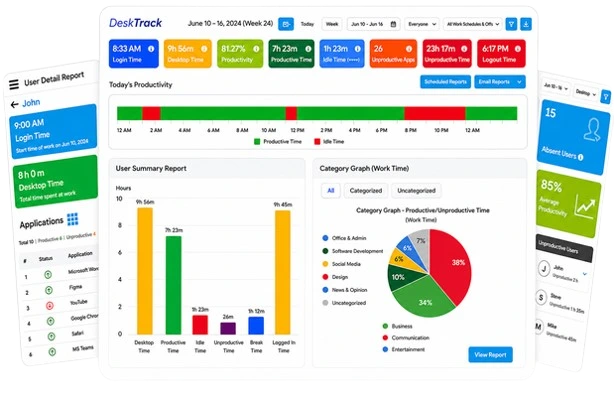
DeskTrack’s powerful time, attendance, and workforce tracking software solution provides you with real-time insights into how and when your employees are working. You can configure and track your standard business weeks with the tool’s user-friendly interface. Additionally, with its project management features, you can streamline workflows, and you also get the most cost-effective and scalable productivity monitoring software integrated to maximize productivity on every business day. Try now and realize why businesses around 100+ countries have implemented it already.
Frequently Asked Questions (FAQ)
Q. How Many Business Days are in a Month?
Ans. Considering that there are 4-5 weeks a month, and the business week is Monday to Friday, there are 20-25 business days per month in the USA on average.
Q. What Do 3 to 5 Business Days Mean?
Ans. 3-5 business days is equivalent to 3-5 weekdays in layman’s terms. However, if there is a holiday in between, it won’t be counted. For example, Monday to Thursday, or Friday to Friday.
Q. How Long is 7 to 10 Business Days?
Ans. 7-10 business days are generally between one and a half to two weeks. If you start counting down from a Monday, the timeline will end on the next week’s Wednesday or Friday.
Q. Is Saturday a Business Day?
Ans. Saturday is usually not a business day in the USA. However, it can be a business day in other countries. For Example, India and Brunei.
Q. How Long is 1 or 2 Business Days?
Ans. 1 business day is 2 consecutive days with or without a holiday or weekend in between, for example, Tuesday to Wednesday, or Friday to Monday. Likewise, an example of 2 business days will be Monday to Wednesday, or Friday to Tuesday.