Picture this: it’s the end of the quarter, and your team has been visibly busy all month. But the results? Disappointing, The deadlines slipped. The quality wasn’t there. And you can’t quite put your finger on why.
Sound familiar? You’re not alone. According to Gallup’s State of the Global Workplace report, only about 23% of employees worldwide are actively engaged at work. The rest? They’re either coasting or quietly checked out — and it’s costing businesses trillions of dollars every year.
The good news: poor work performance is rarely about lazy employees. It’s almost always about broken systems, unclear expectations, and missing tools. Fix those, and you fix the performance problem.
This guide gives you 25 practical, proven strategies to improve work performance — whether you manage a team of five or five hundred. Let’s get into it.
By the numbers: Disengaged employees cost companies approximately 34% of their annual salary in lost productivity (Gallup, 2023). Organizations using data-driven employee monitoring software see 20–30% efficiency gains within the first quarter of implementation.
Why Improving Work Performance Actually Matters
Before we dive into the strategies, let’s get clear on what’s at stake. Work performance isn’t just a buzzword for annual reviews — it’s the single biggest driver of business outcomes.
When employees perform well, the effects compound across your entire organization: customer satisfaction goes up, team morale improves, attrition drops, and profits follow. On the flip side, when performance suffers, the damage is rarely isolated to one person or one project. It ripples outward.
High-performing organizations share a common trait: they build systems and cultures that make great performance the default — not the exception. That’s exactly what we’re going to help you build.
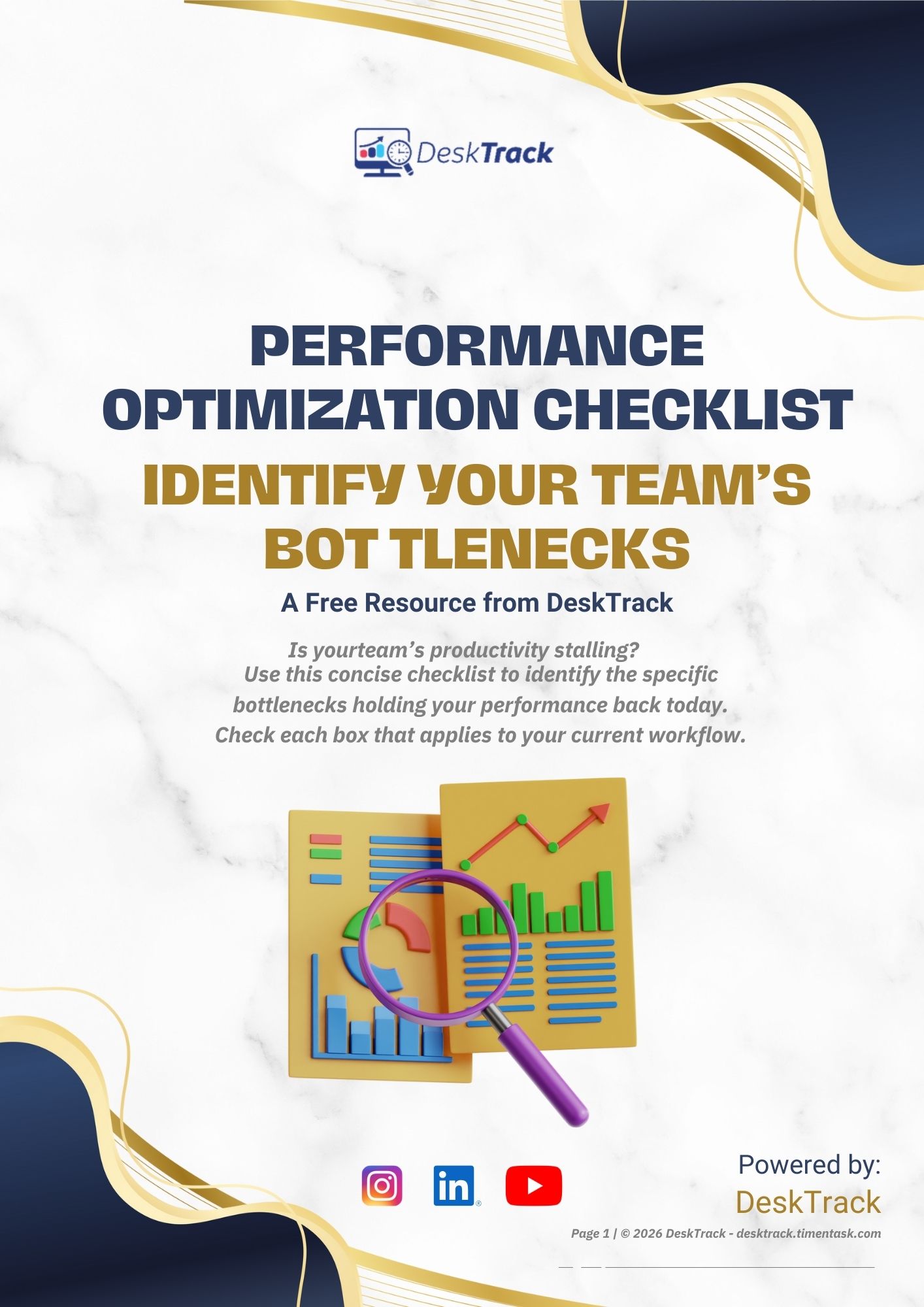
Download this accurate and reliable optimization checklist to identify the specific bottlenecks holding your performance back today!Free Performance optimization checklist
What’s Silently Killing Your Team’s Performance?
Here’s an uncomfortable truth: most performance problems aren’t employee problems. They’re leadership and systems problems. Knowing the root causes is the first step toward fixing them.
- Unclear expectations.Employees can’t hit a target they can’t see. Vague instructions lead to rework, missed deadlines, and frustration on both sides.
- Too many meetings.Research from Harvard Business Review found that executives waste an average of 23 hours per week in meetings. And it takes an employee around 25 minutes to fully refocus after an interruption.
- No feedback loops.Without timely, specific feedback, employees repeat mistakes and miss opportunities to grow.
- Burnout and overwork.High performers don’t quit jobs — they quit environments that drain them without refueling them.
- Outdated tools.Asking modern teams to operate on outdated systems is like asking them to run a race in concrete shoes.
- Missing growth opportunities.When employees stop growing, they start leaving — or worse, they stay and disengage.
- Recognition gaps.A simple “great work” carries more weight than you think. Its absence carries even more.
- Micromanagement.It destroys trust, kills creativity, and signals to your best people that there’s no room for autonomy.
Stop guessing where productivity is being lost
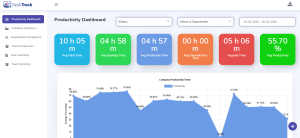
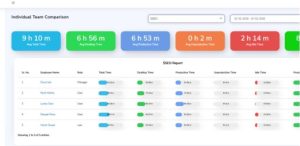
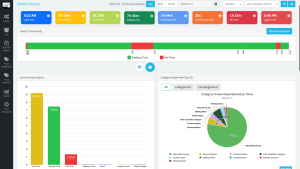
DeskTrack gives you real-time visibility into how your team spends their time — so you can fix problems before they become patterns.
25 Ways to Improve Work performance (That Actually Work)
These aren’t generic motivational tips. Each strategy below is grounded in behavioral science, organizational psychology, or real-world implementation. Pick the ones most relevant to your team’s situation and start there.
1. Set SMART goals — and make them visible
Vague goals produce vague results. SMART goals (Specific, Measurable, Achievable, Relevant, Time-bound) give employees a clear finish line to run toward. Critically, goals shouldn’t live in a manager’s head — they should be visible, shared, and tracked. Tools like DeskTrack let you configure team-level productivity benchmarks so that everyone knows what “good” looks like for their role.
2. Track progress consistently
A goal without a tracking mechanism is just a wish. Regular check-ins — weekly, not monthly — help catch course corrections before they become course corrections. Use a KPI dashboard to make progress tangible and motivating.
3. Communicate with radical clarity
Ambiguity is the enemy of execution. The best-performing teams communicate obsessively: who owns what, what the deadline is, and what “done” looks like. When confusion is removed, quality goes up and frustration goes down.
4. Prioritize high-impact work first
Not all tasks are created equal. Teach your team to identify their highest-leverage work and protect time for it. The Eisenhower Matrix is a simple framework — urgent vs. important — that helps employees stop reacting and start executing with intention.
5. Make time management a team skill, not just a personal one
Time management isn’t just about individual willpower. It’s a skill that can be trained and supported. Using time tracking software helps employees see where their hours actually go — often revealing surprising patterns, like hours spent on low-value tasks that could be delegated or eliminated.
6. Build a real feedback culture
Feedback shouldn’t be a once-a-year event. According to Forbes, employees who receive regular, meaningful feedback are three times more likely to stay engaged at work. Make feedback frequent, specific, and two-directional.
7. Trust your people with accountability
The paradox of micromanagement: the tighter you hold the reins, the worse performance gets. Giving employees clear ownership of outcomes — and trusting them to figure out the path — produces dramatically better results than monitoring every step.
8. Kill multitasking
Science is clear on this: multitasking doesn’t make you faster. It makes you slower and error-prone. A Stanford study found that heavy multitaskers performed significantly worse on cognitive tests. Encourage deep focus work in blocks, and protect those blocks from interruptions.
9. Engineer a distraction-free environment
Open offices, notification pings, and casual drop-bys all have a cost. Help your team design their work environment — physically or digitally — to minimize interruption. Some of the most impactful changes are the simplest: silencing notifications during focus hours, using headphones as a “do not disturb” signal, or blocking distracting sites during deep work sessions.
10. Reduce meetings ruthlessly
Aim for 1–2 strategic meetings per week, maximum. Every unnecessary meeting doesn’t just waste the meeting time — it destroys the focused work time on either side. Use project time tracking data to identify when issues actually warrant a group conversation vs. an async update.
11. Automate the repetitive stuff
Every hour your team spends on manual admin work is an hour they’re not spending on the work they were actually hired to do. DeskTrack automatically generates timesheets, processes attendance data, and logs activity — so your team focuses on execution, not paperwork.
12. Invest in collaboration structure
Collaboration works best when it’s structured, not spontaneous. Define how teams work together: when to sync, how to share updates, and what tools to use. This is especially critical for hybrid and remote teams where ad-hoc communication breaks down.
13. Give people the right tools
The wrong tools create friction that compounds every single day. Evaluate your tech stack through one lens: does this make it easier or harder for my team to do their best work? Time management tools that work invisibly in the background — rather than demanding active input — tend to get the highest adoption and produce the clearest data.
14. Don’t neglect ergonomics and physical setup
Discomfort is a silent performance killer. Poor posture, bad lighting, and slow computers cost more in lost productivity than the investment required to fix them. This isn’t a soft perk — it’s a hard performance issue.
15. Train people properly and continuously
Untrained employees don’t underperform because they don’t care — they underperform because they don’t know better. The ROI on training is consistently 150–200% when you factor in reduced errors, improved retention, and faster execution.
16. Create visible growth paths
Employees who see a future inside your organization outperform those who don’t. Career pathing, skill-building programs, and mentorship opportunities don’t just improve retention — they drive daily performance because people invest more in work they feel connected to.
17. Recognize achievements publicly and specifically
Generic praise is forgettable. Specific, public recognition is powerful. Saying “Alex shipped the client dashboard two days ahead of schedule and the client loved it” does more for team culture than a generic “good work this month.”
18. Build psychological safety into your team culture
Teams where people are afraid to speak up, share mistakes, or challenge ideas consistently underperform. Google’s famous Project Aristotle found that psychological safety was the single biggest predictor of team performance — more than skill, experience, or any other factor.
19. Break down silos with cross-functional work
Isolated teams develop blind spots. Bringing together people from different functions — even just for a single project — builds empathy, expands knowledge, and often surfaces the best ideas.
20. Monitor for burnout before it happens
By the time burnout is visible, it’s already costly. DeskTrack’s screen monitoring software and overtime tracking features help managers identify unusual patterns — consistently late hours, dropped productivity, irregular login times — that often signal a team member heading toward burnout, so you can intervene early.
21. Offer meaningful flexibility
Flexibility isn’t just a perk anymore — it’s a performance driver. When employees have more control over when and where they work, their engagement and output improve measurably. The key is structured flexibility: clear outcomes and boundaries, not free-for-all schedules.
22. Protect rest as actively as you protect work time
Chronic overwork doesn’t produce more output — it produces lower-quality output for longer periods. The highest-performing individuals and teams build recovery into their schedule deliberately, not as an afterthought.
23. Create mentorship opportunities (in both directions)
Pair senior employees with newer ones for traditional mentoring — and consider reverse mentoring, where junior team members share fresh perspectives and digital skills with leadership. Both forms accelerate learning and build cross-generational trust.
24. Listen and act on what you hear
Employee surveys are common. Acting on the results is rare. The teams that improve most consistently are the ones where leaders close the loop: “You told us X, so we’re doing Y.” That simple act of visible responsiveness transforms how employees relate to their organization.
25. Use data to drive continuous improvement
Gut feelings are a starting point, not a strategy. Workforce analytics give you objective insights into productivity patterns, efficiency trends, and team performance over time — so every improvement decision is grounded in evidence, not assumption.
How DeskTrack helps teams improve work performance — without micromanaging
Most performance tracking tools feel invasive. DeskTrack is built differently — giving managers the data they need while keeping teams focused, not surveilled. Here’s what makes it different:
- Real-time activity tracking
See exactly where work hours go — by app, URL, and project — without interrupting your team. - Automated timesheets
Zero manual entry. Accurate records. Payroll that runs itself. - Burnout detection
Overtime alerts and productivity patterns flag at-risk employees before problems escalate. - Project-level insights
Know which projects are on-track and which are bleeding time with project time tracking. - Workforce analytics
Turn time data into actionable performance insights across teams and departments. - Remote & hybrid ready
Monitor employee performance whether your team is in-office, remote, or hybrid — consistently.
This ensures a balance between accountability and privacy.
How to Actually Measure Work Performance
Improving performance starts with measuring it honestly. Here are the key dimensions to track — and what each tells you about your team:
| Performance Dimension | What to Measure | Why It Matters |
|---|---|---|
| Task completion | On-time delivery rate, backlog age | Reveals workload imbalances and planning gaps |
| Quality of output | Error rate, revision cycles, client satisfaction scores | Shows whether speed is coming at the cost of quality |
| Time efficiency | Billable vs. non-billable hours, idle time percentage | Identifies where productive hours are being lost |
| Goal achievement | KPI completion rate, OKR progress | Connects daily work to strategic priorities |
| Employee engagement | Pulse survey scores, absenteeism, voluntary turnover | A leading indicator of future performance trends |
| Collaboration quality | Peer feedback, cross-team project contribution | Surfaces interpersonal dynamics that affect team output |
| Wellbeing indicators | Overtime frequency, break patterns, sick days | Early warning system for burnout and disengagement |
See DeskTrack in action — no commitment needed
Book a personalized demo and we’ll walk you through exactly how DeskTrack can improve performance visibility for your specific team setup.
Manual Tracking vs. DeskTrack: What’s The Real Cost?
Many teams still rely on manual timesheets and gut-feel performance reviews. Here’s how that stacks up against a data-driven approach:
| Feature | Manual / Traditional | DeskTrack |
|---|---|---|
| Timesheet accuracy | Human error-prone, often estimated | ✓ Automated, second-by-second accuracy |
| Performance visibility | Monthly reviews, subjective | ✓ Real-time dashboards |
| Burnout detection | ✗ Not possible | ✓ Overtime alerts + pattern analysis |
| Remote team monitoring | Trust-based, no visibility | ✓ Full visibility, no micromanagement |
| Project-level data | Estimated or missing | ✓ Accurate per-project time breakdowns |
| Setup time | Ongoing manual effort | ✓ Automated after initial setup |