Most businesses already know what employee monitoring software does. But knowing what it does and understanding the tangible benefits it delivers for your business are two very different things.
The benefits of monitoring employees at work go far beyond simply seeing who is online. When implemented correctly, employee monitoring software transforms how businesses plan, manage, evaluate, and grow their teams — delivering measurable returns across productivity, accountability, compliance, and profitability.
This guide covers the 10 most significant benefits of employee monitoring software for businesses in 2026 — backed by data, explained with real use cases, and grounded in how modern tools like DeskTrack actually deliver these outcomes.
Why the Benefits of Employee Monitoring Go Beyond Time Tracking
The phrase ’employee monitoring’ often triggers a narrow mental image — a manager watching a live screen feed. This misunderstands what modern workforce monitoring software actually is and what it actually does for a business.
Modern platforms like DeskTrack are not surveillance tools. They are workforce intelligence platforms that collect objective data about how work time is spent, then surface that data in dashboards, reports, and alerts that help leaders make better decisions.
The benefits of monitoring employees at work become clear once you understand what the data actually reveals. Most businesses discover, within their first week of deployment, that their assumptions about how time was being used were significantly wrong — and that the gaps are both larger and more fixable than they expected.
According to internal DeskTrack data, 78% of new customers identify at least one major workflow inefficiency within their first 72 hours of deployment that they were previously unaware of.
This ensures a balance between accountability and privacy.
Boost your team’s productivity ➡
10 Key Benefits of Employee Monitoring Software for Businesses in 2026
Each benefit below is explained with the business problem it solves, how monitoring software addresses it, and the measurable outcome businesses typically see.
Benefit 1: Significant Increase in Employee Productivity
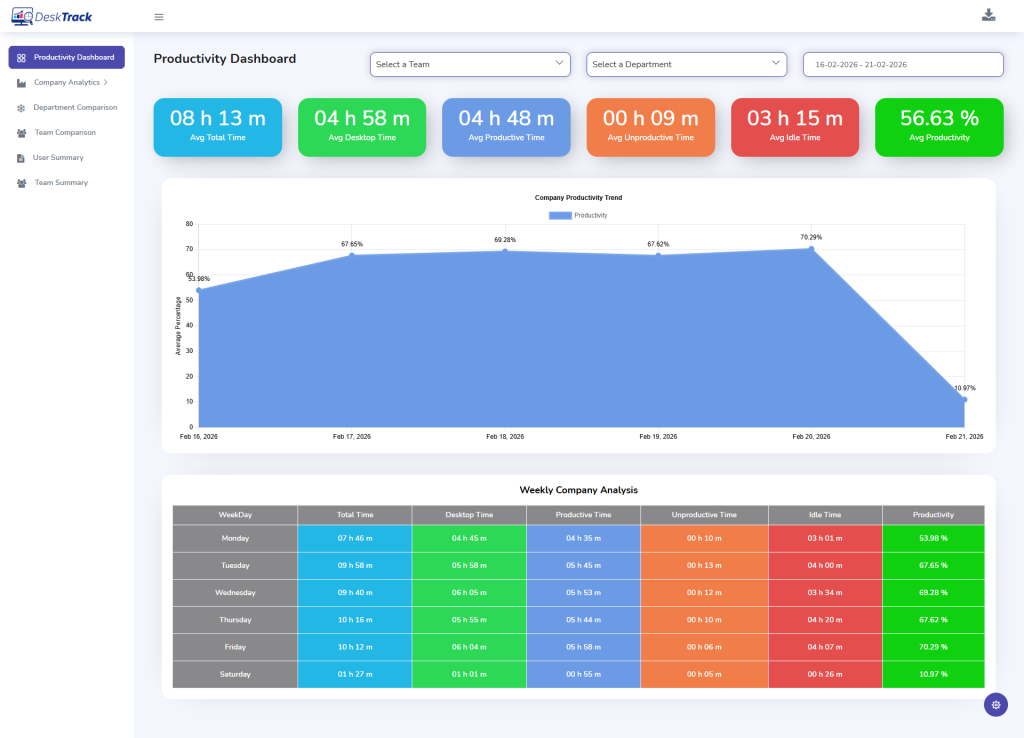
Productivity loss is rarely about laziness. It is almost always about invisible structural problems — unclear task priorities, excessive context-switching, unproductive application usage, and meeting overload that no manager can see without data.
Employee monitoring software gives managers the data to identify exactly where productivity is being lost and fix the root cause rather than guessing. When employees know that their active and idle time is being measured objectively, they naturally reduce unproductive behaviour — not because they are being watched, but because accountability creates focus.
The business outcome is direct:
- Teams using DeskTrack report an average 40% productivity improvement within the first week
- Idle time — the largest hidden productivity drain — drops by an average of 28% within 30 days
- Peak-focus hours become visible, allowing managers to protect deep work time from unnecessary meetings
Real result: A 50-person IT company using DeskTrack recovered 11 hours of productive time per employee in their first month — the equivalent of hiring 2.75 additional full-time staff without any additional cost.
Read More: What Is Employee Monitoring Software? A Complete Guide for 2026
Benefit 2: Accurate Payroll, Billing, and Time Accountability
One of the most direct and quantifiable benefits of monitoring employees at work is the elimination of payroll waste from inaccurate time records. Most businesses rely on self-reported timesheets — a practice that research consistently shows is inaccurate by 30 to 50%.
For service businesses, agencies, and any team that bills clients by the hour, this inaccuracy represents direct revenue leakage. Time spent on calls, client reviews, or research that goes unlogged is billable work that never gets invoiced.
DeskTrack solves this by automatically capturing every minute of work activity:
- Application-level tracking shows exactly how time was distributed across tools and tasks
- Project-based time attribution connects tracked hours directly to specific client projects
- Mobile call log tracking captures phone-based work that desktop tools completely miss
- Automated timesheets replace manual logs with accurate, system-generated records
For Indian enterprises with statutory compliance requirements, DeskTrack’s biometric attendance sync ensures payroll records are legally defensible and audit-ready.
Benefit 3: Real-Time Visibility into Remote and Hybrid Teams
Managing remote employees without monitoring data is the equivalent of managing an in-office team with the lights off. You know people are there. You just cannot see what they are doing.
This visibility problem is the primary driver of monitoring software adoption in 2026. With over 60% of knowledge workers now in hybrid or fully remote environments, workforce visibility has become a technology problem — and one of the most important benefits of employee monitoring software is its solution to it.
DeskTrack provides managers with:
- Live dashboards showing each team member’s active status, current application, and productivity score
- Unified visibility across office workers, remote employees, and GPS-tracked field staff
- Mobile call log analytics for sales and support teams whose work happens primarily on the phone
- Timestamped activity logs that create an objective record of when and how work occurred
DeskTrack is one of the only platforms globally that unifies desktop activity, GPS field tracking, and mobile call logs in a single dashboard — eliminating the visibility blind spots that affect every other monitoring tool on the market.
Benefit 4: Reduced Idle Time and Elimination of Payroll Waste
The average employee is idle for 1.5 to 3 hours per working day. Across a 50-person team, this represents 75 to 150 hours of paid, unproductive time every single day — or between 1,500 and 3,000 hours per month.
Idle time is not always wilful. Much of it comes from structural inefficiencies: unclear task priorities that leave people waiting, review cycles that stall progress, context-switching after interruptions, and over-scheduled meetings that consume focus time. Without monitoring data, managers cannot distinguish between genuine idle time and workflow friction.
Employee monitoring software makes idle time visible and actionable:
- Idle time reports show exactly when and for how long each employee’s system was inactive
- Context-switching data reveals the cost of interruptions on focused work time
- Comparison reports identify which team members or departments have abnormally high idle rates
- Trend data shows whether idle time is improving or worsening over time after interventions
Benefit 5: Data-Driven, Fair Performance Reviews
Performance reviews built on manager perception are inherently unfair. The employee who communicates loudly and presents work well tends to be rated higher than the employee who works quietly and delivers consistently — regardless of actual output.
One of the most important benefits of monitoring employees at work is the replacement of subjective perception with objective performance data. When managers have access to activity logs, productivity scores, project completion rates, and time distribution data, performance conversations become fundamentally different — and fundamentally fairer.
This benefit has a direct impact on employee engagement and retention:
- Employees who are evaluated on objective data report feeling more fairly assessed
- High performers who were previously underrecognised become visible in the data
- Underperformers can be coached with specific, evidence-backed feedback rather than vague impressions
- Dispute resolution in HR processes becomes straightforward with timestamped activity records
Research published in the Journal of Applied Psychology found that transparent, data-based performance feedback increases employee engagement by 14% and reduces voluntary turnover by 9%. Employee monitoring data is a direct enabler of this feedback model.
Benefit 6: Improved Project Planning and Delivery Accuracy
Most project delays are not caused by insufficient effort — they are caused by inaccurate planning. When project estimates are built on self-reported timesheets or historical guesses, they do not reflect the actual time required to complete specific tasks in your specific team context.
Employee monitoring software solves this by generating accurate baseline data for every type of task your team regularly performs. Over time, this data makes your estimates significantly more accurate — turning delivery predictions from optimistic guesses into data-backed commitments.
The project planning benefits of employee monitoring are concrete:
- Project-level time tracking shows actual versus estimated hours for every task and sprint
- Historical data reveals which task types consistently take longer than estimated
- Capacity planning improves when managers can see each team member’s real workload and availability
- Bottleneck identification becomes possible when handoff delays appear in the data
DeskTrack customers in software development and digital agencies consistently report that sprint accuracy improves significantly within two to three months of deployment — not because their teams work harder, but because their estimates are finally grounded in real data.
Benefit 7: Compliance, Security, and Data Loss Prevention
For businesses in regulated industries — finance, healthcare, legal, and government — employee monitoring software is not just a productivity tool. It is a compliance infrastructure.
Knowing who accessed which system, when, and for how long is a core requirement for GDPR compliance, HIPAA audit readiness, and India’s IT Act data security standards. Without automated activity logging, demonstrating compliance during an audit requires manual record-keeping that is both time-consuming and unreliable.
DeskTrack’s compliance and security benefits include:
- Auditable activity logs that create a tamper-evident record of all system access
- Data leak protection that tracks file transfers and detects USB device usage in real time
- Screenshot monitoring that provides visual evidence of desktop activity during work hours
- Sensitive application access tracking that logs every interaction with financial or patient data systems
- GDPR-compliant data handling with documented retention policies and employee access rights
For Indian enterprises, DeskTrack’s biometric integration ensures that physical attendance data is reconciled with digital activity records — meeting statutory compliance requirements without additional manual work.
Benefit 8: Significant Reduction in Operational Costs
The ROI of employee monitoring software is measurable, fast, and consistent. The cost reduction comes from multiple sources simultaneously — and most businesses reach full payback on their investment within the first 90 days.
See All 10 Benefits in Action — Free for 15 Days
Join 1000+ professionals who use DeskTrack to recover idle payroll hours, improve accountability, and make data-driven workforce decisions.
| Cost Reduction Source | How Monitoring Delivers It | Typical Impact |
| Idle payroll recovery | Identifying and reducing idle time across the workforce | 28% reduction in idle hours within 30 days |
| Accurate client billing | Capturing all billable time including phone and field work | 8-15% increase in billable hours invoiced |
| Reduced HR overhead | Automated attendance, timesheet, and payroll data | 2-4 hours saved per manager per week |
| Lower staff turnover | Fairer performance reviews reduce disengagement | Up to 9% reduction in voluntary turnover |
| Faster project delivery | Accurate planning reduces costly deadline failures | 35% fewer missed deadlines reported by agency customers |
| Software licence audit | App usage data identifies unused or redundant tools | Average 12% reduction in software licence spend |
Benefit 9: Faster, Smarter Onboarding for New Employees
New employee onboarding is expensive. The average cost of onboarding a new hire is estimated at $4,000 to $7,000 in the US, and the productivity ramp-up period typically takes three to six months. Without data, managers have no way of knowing whether a new employee is on track or silently struggling.
Employee monitoring software shortens the onboarding visibility gap by giving managers real data on how new employees are spending their time from day one. This creates earlier coaching opportunities, faster identification of training gaps, and a more structured ramp-up process.
Specific onboarding benefits include:
- Activity data shows which tools and workflows new employees are engaging with and which they are avoiding
- Productivity trend data reveals whether a new hire’s output is ramping at the expected rate
- Idle time spikes in a new employee’s data often indicate they are blocked or confused — enabling proactive manager intervention
- Peer comparison data helps managers set realistic expectations for ramp-up timelines
This ensures a balance between accountability and privacy.
Benefit 10: A Stronger, More Accountable Team Culture
The final and perhaps most underappreciated benefit of employee monitoring software is its impact on team culture. When monitoring is deployed transparently — with employees given access to their own data and the purpose clearly communicated — it consistently creates a more accountable, more engaged, and more high-performing work environment.
This happens for a specific reason: transparency creates fairness. When everyone on the team knows that their time is being measured objectively, the informal advantages that come from visibility, politics, or self-promotion disappear. Output and effort are what get recognised — because output and effort are what the data shows.
The cultural benefits reported by DeskTrack customers include:
- Teams report feeling more fairly evaluated when performance is based on data rather than manager perception
- High performers feel more recognised because their output is visible in the data, not dependent on self-advocacy
- Managers spend less time on micromanagement because the data answers their questions before they need to ask
- Performance conversations become collaborative rather than adversarial — both parties are looking at the same data
When employees have access to their own productivity dashboards in DeskTrack, usage data shows they check it regularly — not to report to managers, but because they find the data useful for managing their own time more effectively.
Benefits of Employee Monitoring Software by Industry
While the 10 benefits above apply to any business, the specific impact of employee monitoring software varies by industry. Here is how the benefits manifest in the sectors where DeskTrack is most widely used:
| Industry | Primary Benefit | Specific DeskTrack Feature |
| IT & Software Development | Sprint accuracy + deep work protection | Project time tracking, IDE usage detection, idle time analytics |
| BPO & Call Centres | SLA compliance + agent performance | Real-time monitoring, call log tracking, screenshot audit trail |
| Marketing Agencies | Billable hours capture + client billing accuracy | App & URL tracking, project-based time reports, client time logs |
| Finance & Accounting | Compliance + sensitive data access control | Auditable logs, data leak protection, biometric attendance sync |
| Healthcare | HIPAA-aligned audit trails + admin productivity | System monitoring, EHR access tracking, multi-location dashboard |
| Field & Logistics | Route efficiency + time-on-site accountability | GPS tracking, travel route logs, unified desk + field reports |
| Indian Enterprises | Biometric compliance + statutory attendance | Biometric sync, INR payroll integration, multi-branch visibility |
Do the Benefits of Monitoring Outweigh the Privacy Concerns?
This is the most common question businesses ask before implementing monitoring software — and it is a legitimate one. The honest answer is: yes, when monitoring is deployed transparently and ethically.
The concerns about employee monitoring typically stem from a surveillance-first mental model — the idea that monitoring means watching every second of an employee’s screen. This is not how modern monitoring software works, nor how responsible businesses deploy it.
The evidence on employee response to transparent monitoring is consistent:
- Employees who can see their own monitoring data consistently report feeling more fairly treated
- Teams where monitoring is disclosed upfront show no significant increase in stress or job dissatisfaction
- The majority of employees, when surveyed after deployment, prefer objective data-based evaluation to subjective manager assessment
DeskTrack is specifically designed for transparent, ethical deployment. Monitoring is limited to work hours only. Employees have access to their own dashboards. All tracking is disclosed before installation. And data is stored securely with role-based access controls.
The key distinction: monitoring that is used to understand and improve workflows builds trust. Monitoring that is used purely to catch people out destroys it. The same technology, deployed differently, produces entirely different cultural outcomes.
Read More: Top SaaS Tools for Startups to Grow Faster in 2026
How to Maximise the Benefits of Employee Monitoring Software
The businesses that get the most value from employee monitoring software are not the ones who implement the most aggressive settings. They are the ones who deploy it with the clearest purpose, the most transparent communication, and the most consistent use of the data.
Follow this five-step framework to maximise every benefit covered in this guide:
- Step 1: Define what you are measuring and why before you install anything. Decide in advance: are you focused on productivity improvement, billing accuracy, compliance, or a combination? Your monitoring settings should reflect your objective.
- Step 2: Communicate transparently before deployment. Send a company-wide message explaining what is being tracked, why, during which hours, and how the data will be used. Transparency is both an ethical requirement and a practical one — teams that know about monitoring benefit from it more.
- Step 3: Give employees access to their own data. The fastest way to shift monitoring from a surveillance dynamic to a performance improvement dynamic is to let employees see exactly what managers see. DeskTrack supports this out of the box.
- Step 4: Use the data in regular coaching conversations, not just formal reviews. The most valuable use of monitoring data is the weekly check-in where a manager and employee look at the numbers together and identify one specific thing to improve.
- Step 5: Review and adjust settings quarterly. Your team’s workflows change. Your monitoring configuration should evolve with them. Quarterly reviews prevent monitoring from becoming stale or irrelevant — and signal to the team that the tool is being used thoughtfully.
How DeskTrack Delivers These Benefits — What Makes It Different
Most employee monitoring tools deliver some of these benefits some of the time. DeskTrack is built to deliver all ten consistently — because it is the only platform that combines three monitoring layers that every other tool separates:
| Monitoring Layer | What It Captures | Who Benefits Most |
| Desktop & application monitoring | App usage, URLs, idle time, screenshots, project time | All desk-based and remote teams |
| GPS field tracking | Real-time location, travel routes, time-on-site | Sales, delivery, field service, multi-branch |
| Mobile call log analytics | Call duration, frequency, client call timing | BPO, sales teams, account managers |
Every competitor — Hubstaff, Time Doctor, Teramind — tracks desktop activity. None of them track what happens when your team picks up the phone. DeskTrack closes this gap, delivering complete workforce intelligence rather than partial visibility.
For Indian enterprises, DeskTrack adds biometric attendance sync, multi-branch dashboard management, and statutory compliance reporting — features purpose-built for the Indian market that global competitors do not offer.
Used by 100,000+ professionals across 100+ countries. Rated 4.8★ across G2, Capterra, Trustpilot, and Google. Trusted by 1,000+ companies including Honda, Ajanta Pharma, and Patanjali.
This ensures a balance between accountability and privacy.
Conclusion
The ten benefits covered in this guide are not theoretical. They are the consistent, documented outcomes that businesses across industries and team sizes report after implementing employee monitoring software correctly.
Increased productivity. Accurate payroll and billing. Real-time remote team visibility. Reduced idle time. Fair performance reviews. Better project planning. Compliance and security. Operational cost reduction. Smarter onboarding. A stronger team culture.
Every one of these benefits flows from the same source: replacing guesswork with objective data. The businesses winning operationally in 2026 are not working harder than their competitors — they are working with better information.
DeskTrack is built to give every business that advantage — from a 10-person startup to a 10,000-person enterprise — with a single, unified platform that covers desktop, mobile, and field workforce monitoring in one place.
Frequently Asked Questions
Ans. The single biggest benefit is workforce visibility — the ability to see objectively how employee time is being used across your entire organisation. This visibility is the foundation for every other benefit: productivity improvements, accurate billing, better planning, and fair performance reviews. Without data, every other management decision is based on assumption. Ans. Most DeskTrack customers identify their first actionable insight within 48 to 72 hours of deployment. Measurable productivity improvements and idle time reductions are typically visible within the first 30 days. Full ROI — where the software pays for itself — is usually reached within 60 to 90 days. Setup takes under 2 minutes per employee. Ans. For small businesses, every hour of wasted payroll has a proportionally larger impact than it does for large enterprises. The core benefits for small businesses are: accurate billing for client work, identification of which tasks take longer than expected, visibility into remote or hybrid team members, and a structured basis for performance conversations that does not rely on manager intuition alone. DeskTrack scales from teams of 10 with the same full feature set as enterprise deployments. Ans. When deployed transparently — with clear communication, employee access to their own data, and monitoring limited to work hours — research consistently shows that employee morale improves rather than declining. Employees appreciate being evaluated on objective data rather than subjective manager perception. The key variable is how monitoring is deployed and communicated, not whether it is deployed. Ans. DeskTrack customers report recovering an average of $2,400 per employee annually through reduced idle time and improved billing accuracy. For a 50-person team, this typically represents $120,000 in annual value against a software investment of a fraction of that amount. Most businesses achieve full payback within 60 to 90 days of deployment. Ans. The core benefits are the same, but the visibility benefit is significantly more impactful for remote teams because managers have no physical presence as a fallback. For office teams, monitoring primarily adds precision and data to visibility that already exists informally. For remote teams, monitoring creates visibility that would otherwise not exist at all — making it the difference between managing with data and managing completely blind. Ans. Yes. Employees benefit in three specific ways. First, they are evaluated on objective data rather than subjective perception, creating fairer reviews. Second, they can use their own productivity data to identify and improve their personal work patterns. Third, they are protected from unfair accusations because their activity is objectively recorded. When monitoring is deployed transparently, it functions as much as an employee protection tool as a management tool.employee-monitoring-software-benefits